


Students reimagine nurse education using immersive tech: “AI-powered training can fill critical gaps”
June 12, 2025
For Qiwen (Fiona) Xiong, working on Nurse Town has always been personal.
“My mother has been a nurse for over 30 years; during the COVID-19 pandemic, she was recognized as a ‘hero nurse’ for her contributions. I’ve always been incredibly proud of her,” Xiong said. “She often shared stories about the challenges of nurse training. I remember her telling me how nerve-wracking it was when she first started; textbooks taught one thing, but real-world patients were unpredictable. Some may be emotionally unstable, while others struggle to communicate clearly, requiring nurses to develop strong communication and problem-solving skills.”
First created in 2007, Nurse Town is a digital nurse training platform to supplement traditional nursing education. But technology has come a long way since 2007. Together with teammates Yuqi Hu and Liheng Yi, Xiong updated Nurse Town with an LLM integration that offers flexible and realistic patient conversations far beyond what a traditional game script can do, winning them recognition at the Fall 2024 Northeastern in Silicon Valley Student Research Showcase – and the proud approval of Xiong’s mother.
The team first got involved in the project during their research capstone course in the fall of 2024. Their professor Ilmi Yoon had given each student a list of research projects to pick from that were being led by other professors or industry partners, although students were allowed to pitch their own project ideas too. For Hu, the appeal of Nurse Town was the project’s strong connection to public health; he’d done a bachelor’s in clinical psych and a master’s in public health before joining Khoury to pursue an MS in computer science, and he will join the UCSD/SDSU joint doctoral program in public health after graduating.
“What (nursing schools) are doing right now is hiring actors to pretend they are patients, so that the nursing students can practice. But hiring people is expensive, and their students can only access them for a very limited time,” Hu explained. “Nurse Town provides students more opportunities to get this kind of practice – they can run the simulation as many times as they want, whenever they want.”

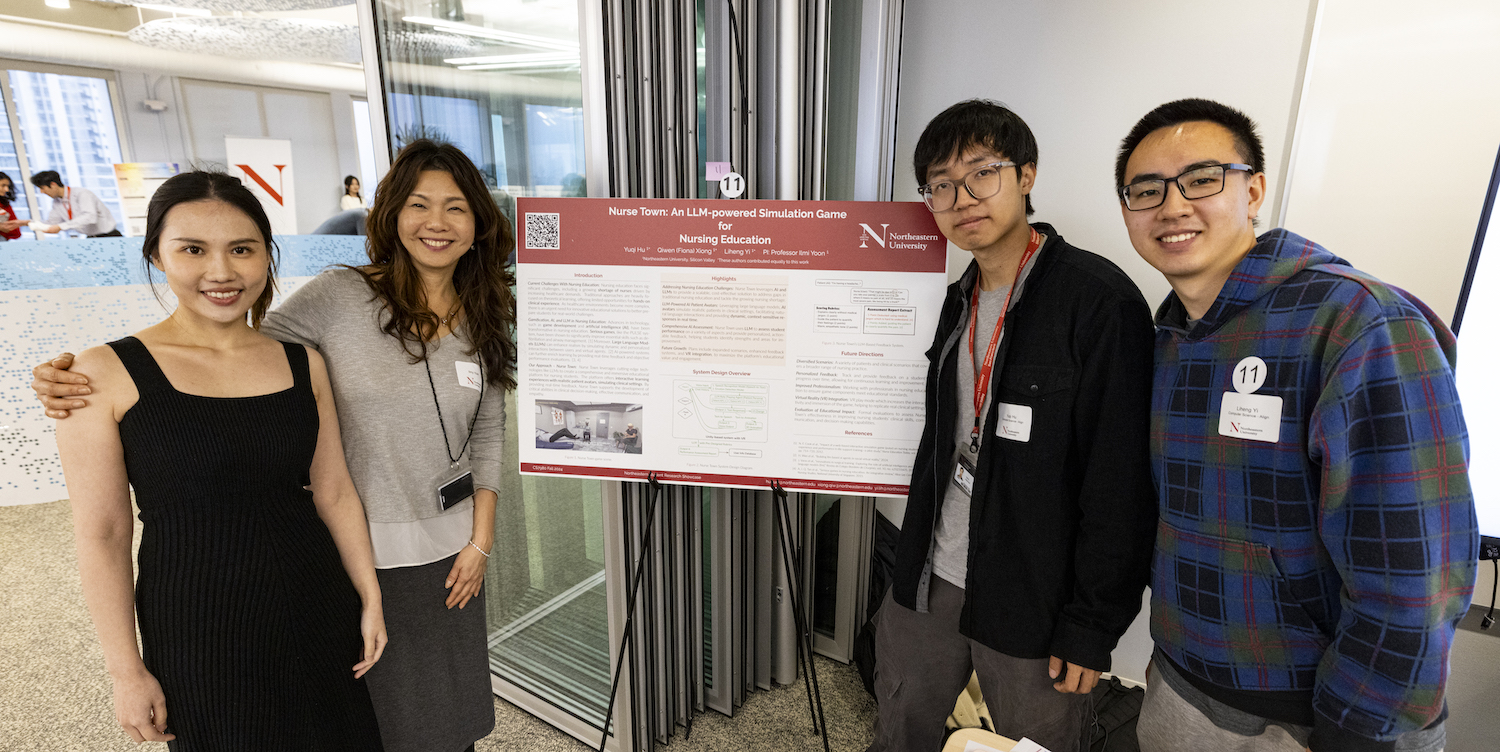
From left: Liheng Yi, Yuqi Hu, and Qiwen (Fiona) Xiong winning recognition in December of 2024
The original Nurse Town used scripts with pre-set conversational options to help nurses practice how to respond to patients in various scenarios, but patients in real life don’t generally stick to the same handful of dialogue options. By replacing those scripts with an LLM chatbot, the student researchers were able to allow nursing students to have much more lifelike and varied conversations with their practice patients. The LLM also controls the patient avatars’ facial expressions and gestures, to ensure conversations and tasks like taking blood pressure feel like they would with a real patient.
“I truly believe that AI-powered training can fill critical gaps in traditional nurse education, making training more comprehensive, realistic, and accessible,” Xiong said.
Both Xiong and Hu are 2025 graduates from the Align program, Khoury College’s bridge curriculum to help students from non-technical backgrounds complete graduate degrees in computer science-related fields (Yi is still a student in the program). Nurse Town was the first time either of them had worked with the game building engine Unity, and coming up to speed with the new platform was tough.
“Basically, I needed to learn Unity from scratch,” Hu said. “How to set up the game scene, how to create a doctor’s office in the game, how to create avatars, and how you write scripts to control those avatars; that was the most challenging part.”
Both students said their supervising professor Ilmi Yoon had been helpful, and still more than anything they recommended taking initiative and diving in headfirst when it came to learning tools like Unity. For Xiong especially, the best learning was happening when she was testing things out for herself.
By the end of the semester the team had created a patient that can be customized with 10 different personalities, to allow nursing students to practice clinical care with a variety of types of people. At Yoon’s encouragement, they applied to present their work at Northeastern in Silicon Valley’s Student Research Showcase, a semesterly event where students present research posters to staff, faculty, fellow students, and industry and community partners. They were accepted, and ultimately won a third-place award for their work.
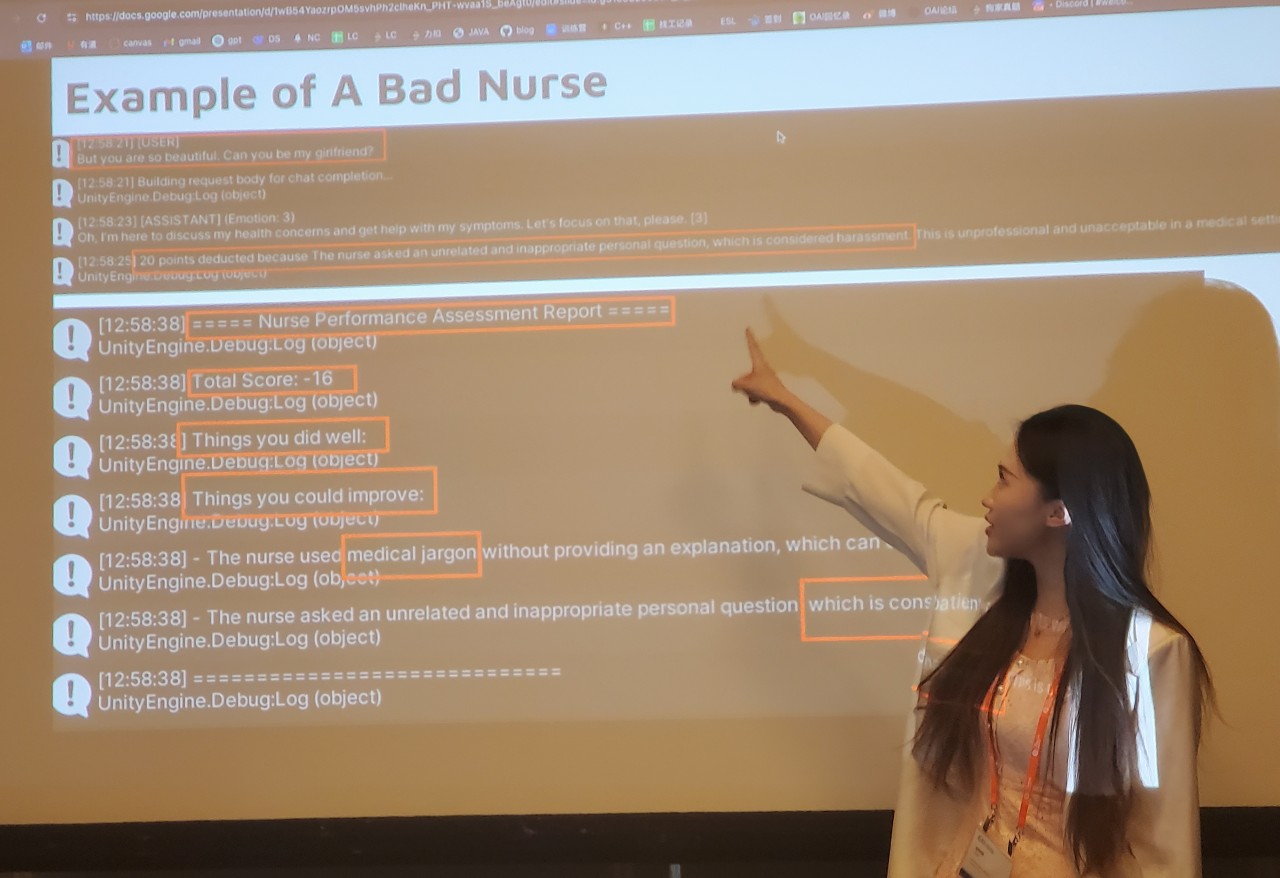
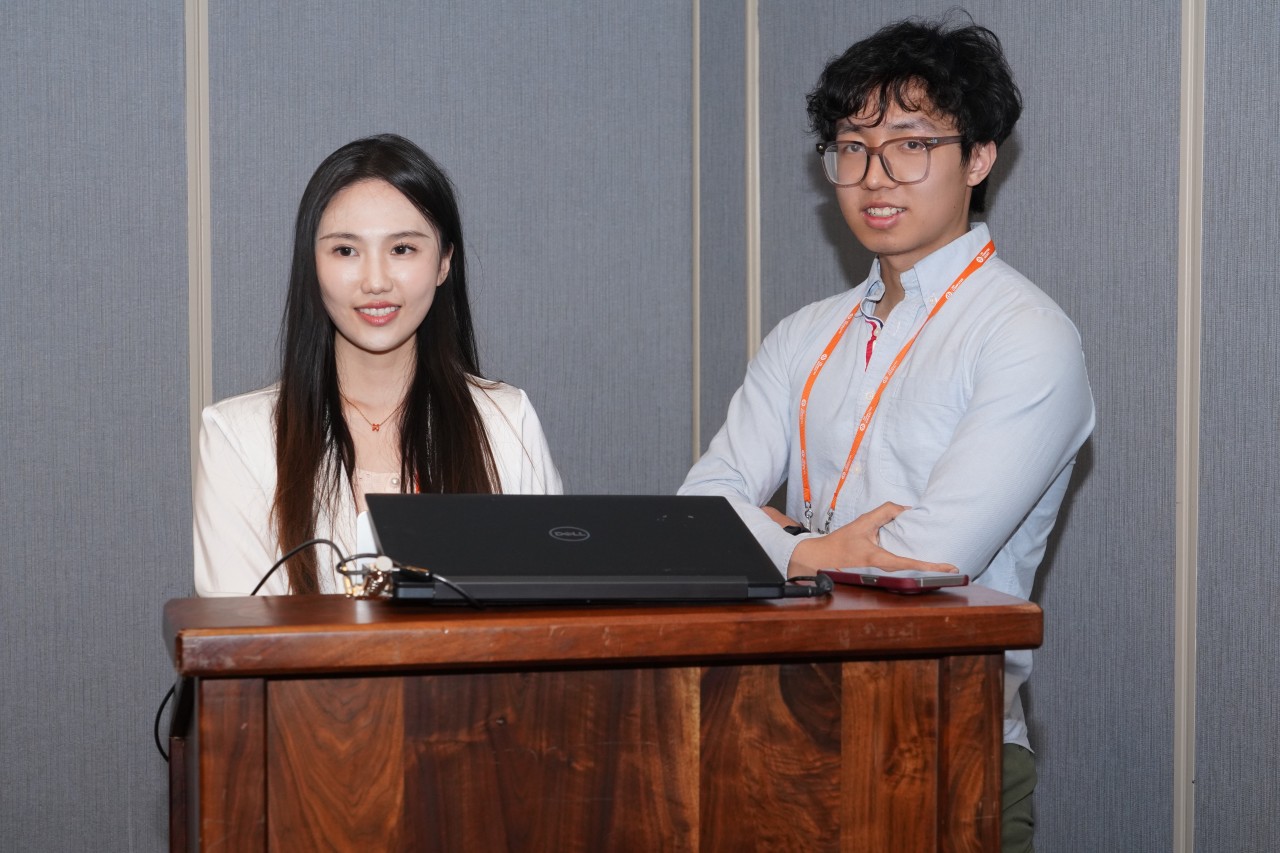
Xiong and Hu presented their work this May at the 2025 IEEE Conference on Artificial Intelliegence
“The research showcase was the first time we showed the demo of the game to other people – outside of those who are on the team – and we got pretty much all positive feedback,” Hu recalled. “It’s not completed, but clearly, people see that there’s potential.”
The team came away from the showcase with a number of ideas for other integrations to make Nurse Town even more useful and lifelike, like immersive VR and an LLM-powered root cause analysis scenario. Bolstered by their success and excited by the possibilities they could see in the technology, Hu and Xiong continued working on the project even after the capstone class concluded, Xiong doing so through the Khoury Research Apprenticeship program. Their paper on NurseTown’s LLM-powered patient was accepted to IEEE CAI 2025, where they presented in early May.
“Since it’s only a computer simulation game, it’s not going to be 100% as effective as in-person practice – we do acknowledge that. What we want to do is make the simulation as close to an in-person simulation as possible,” Hu explained. “I like this project a lot, and I think it has the potential to lead to actual change in real life.”
For Xiong, the most rewarding moment was getting to show her work on Nurse Town to her mother.
“When she saw the minimum viable product, she paused for a moment, then said with deep emotion, ‘Times have truly changed. I really believe that in the future, AI systems like this will help train many great nurses’,” Xiong recalled. “Hearing that from someone who has spent her life in the nursing profession was incredibly fulfilling, and validated the impact of our work.”