Student researchers head to Las Vegas to attend CES 2026
February 13, 2026
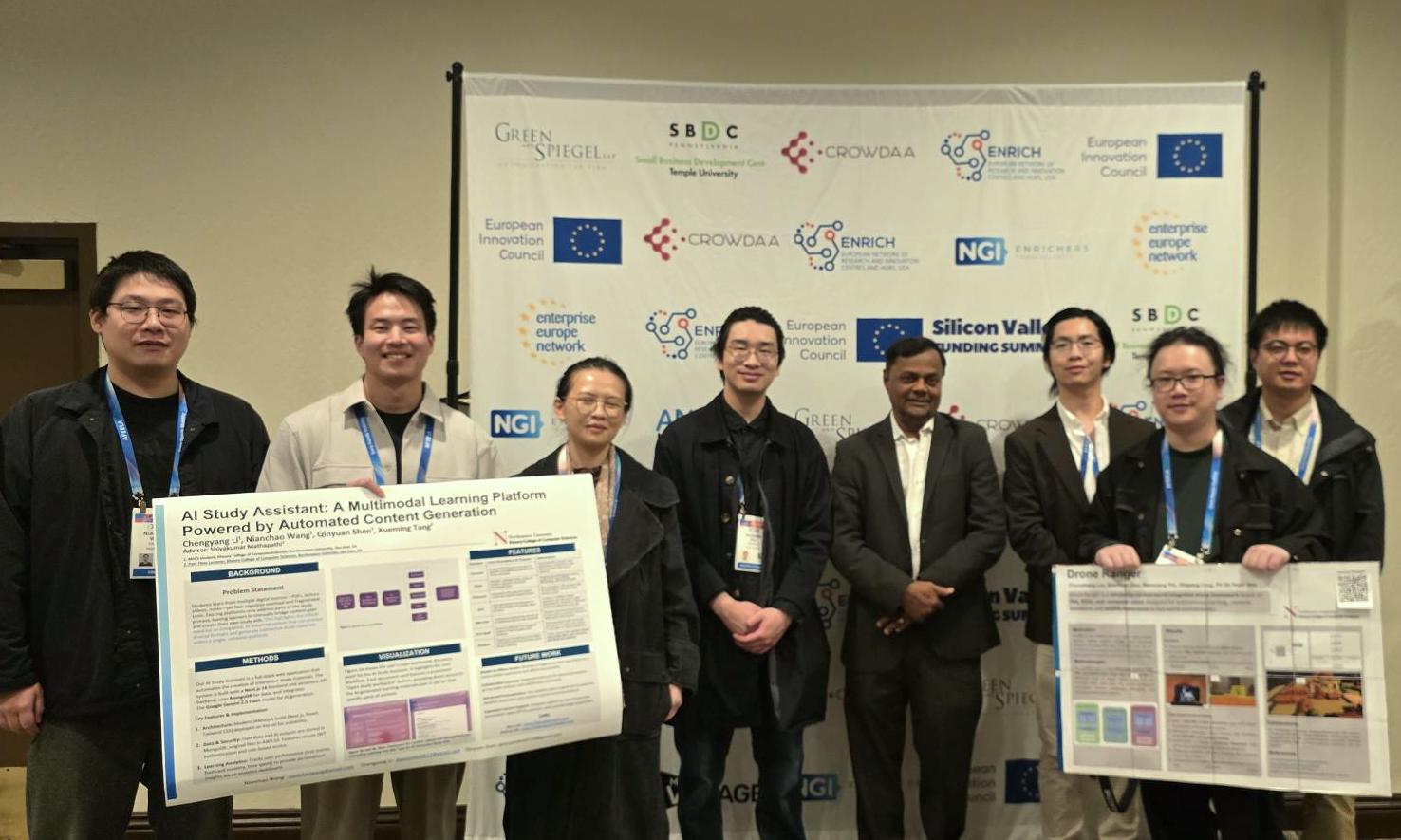
One might think that the best way to deter the deer grazing in your backyard would be a big fence or a guard dog, but for a team of Northeastern student researchers, operating a drone might be more effective. DroneRanger was one of the two teams of student researchers who pitched investors at the Silicon Valley Funding Summit before attending the Consumer Electronics Show, both held in Las Vegas this past January.
At the first event, students participated in workshops as teams and pitched panels of investors, giving them a crash course in entrepreneurship amidst the 60+ investors and companies participating in the summit. They created posters and learned how to demonstrate value to a potential customer. The two teams attending the events this year were presenting products called DroneRanger and AI Study Assistant.
Taking research out of the classroom
For the past three years, Northeastern lecturer and industry researcher Shivakumar Mathapathi has given students an opportunity to attend both events to provide them with meaningful startup and pitching experience as well as research opportunities.
“This is my goal: connect students to industry,” Mathapathi said. “As part of participating in the summit, student teams qualify for a pass to the CES show. They were excited to attend keynotes like Lenovo World to hear how companies are connecting the physical and digital worlds.”
Mathapathi noted that it is often difficult for students to get tickets to events like Lenovo World, which was held in the popular Las Vegas Sphere venue.
“It was so cool,” AI Study Assistant team member Chenyang Li (Align MS in Computer Science ‘26) said. “Lots of robotics companies; we got to see new technologies in the physical AI domain connecting smart devices together. In the future, a lot of local files will be part of your AI training materials, changing how you study and work.”
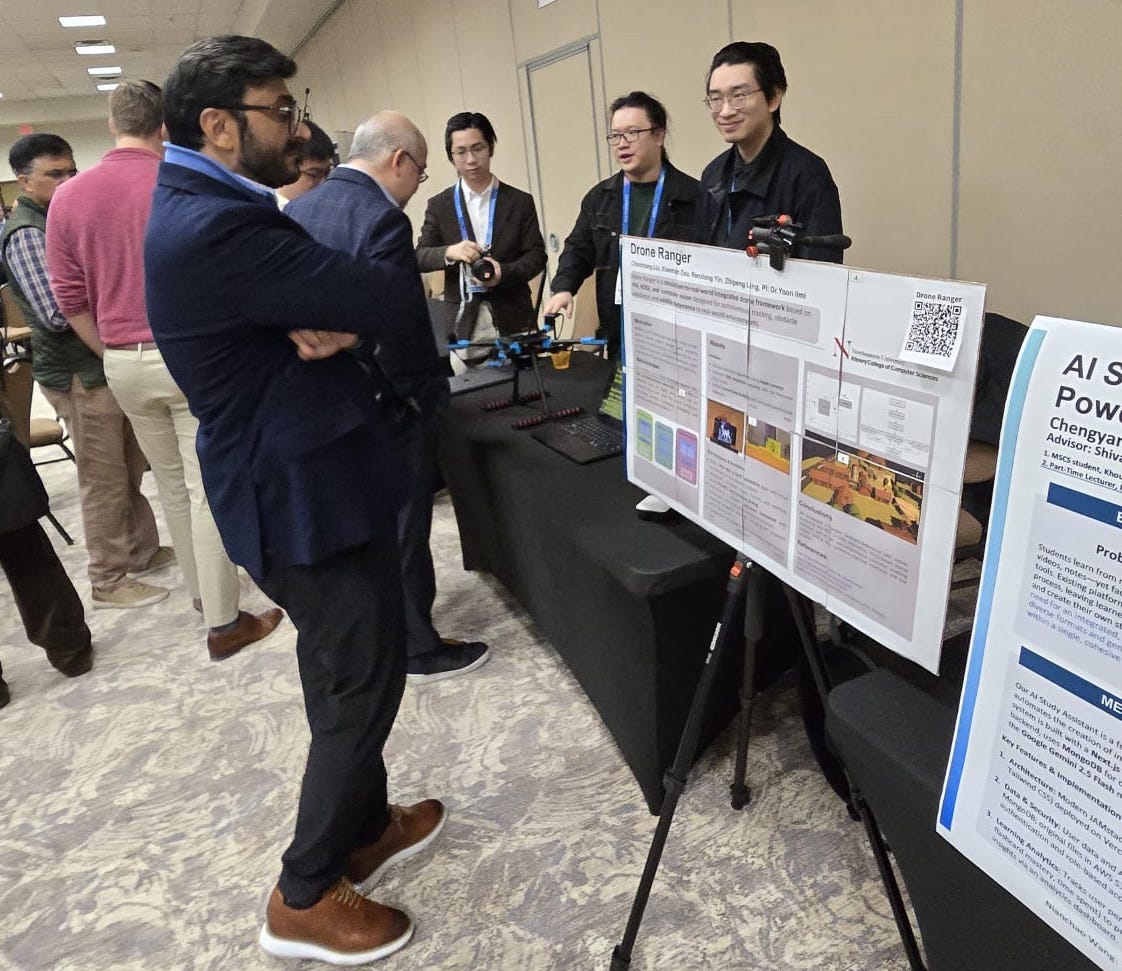
The DroneRanger team talking with conference attendees
Finding inspiration for new research, right in your own backyard
The five DroneRanger team members, Zhipeng Ling, Renxiang Yin, Jiading Zhou, Chunzhang Liu, and Xioman Zou, met through previous classes and hackathons, as well as through the student-faculty NEURAI Lab. Lab chair and Northeastern Silicon Valley director of computing programs Ilmi Yoon served as their advisor.
“Dr. Yoon lives in the hills, and there were a lot of wild animals harming her backyard plants,” Yin (MS in Computer Science ’26) explained. “She tried walls and sound waves, but they’d still come. So, we had an idea of using a drone as a harmless way of getting the animals to leave.”
Building the DroneRanger involved integrating four elements. It needed an autonomous software “pilot,” decision-making software “captain,” a camera, and a functioning drone kit with battery and GPS. The team developed the project in real world environments and a virtual environment, initially using the platform Unity and later adding Nvidia’s physics platform. The team leveraged computer vision AI to develop their own decision-making algorithm. This algorithm proved the most valuable element.
“During the pitch events, we realized we needed to make the application more inclusive beyond just backyards,” Zou (MS in Computer Science ’26) said. “The logic components could be highly modular like data recognition, object tracking, and pathfinding. Right now, the drone market is very vertical, and we saw we could provide a modular cloud platform backed by our robust data pipeline from the virtual environment testing.”
Dr. Yoon concurs and sees a lot of commercial potential for the team’s work in the market – as well as their ambition.
“The drone flying algorithm itself is a very hot topic,” Yoon said. “Drone technology is very strong in China, but in the USA, we need to develop more applications. The team started without a drone expert, and every week they found new knowledge, then iterated to move forward. Every meeting with them has been an ‘oh, wow’ moment. The spirit of our lab encourages students to solve problems in areas where they didn’t have prior experience.”
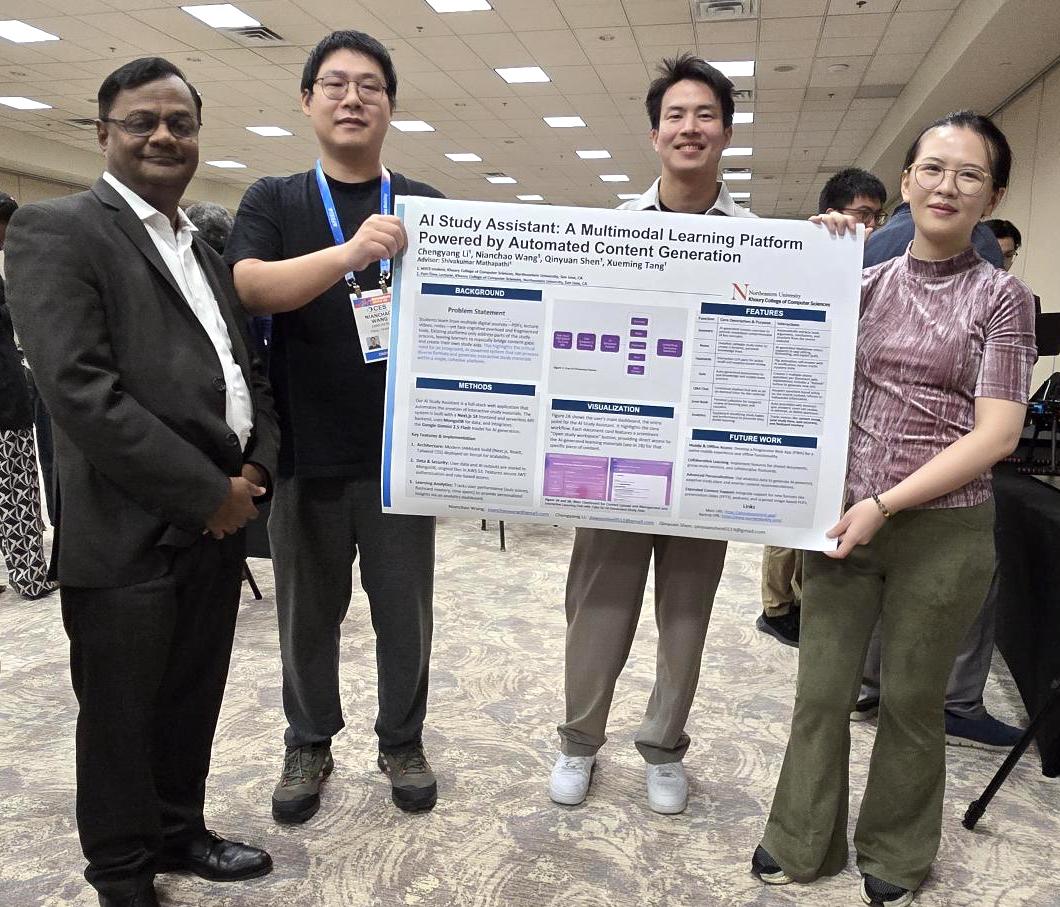
Prof. Mathapathi and the AI Study Assistant team
Product iterations in a competitive landscape
Mathapathi played the role of faculty mentor to the second team, AI Study Assistant, a project which came out of his foundation in software engineering course. During the course, students form teams and develop an idea and prototype. This team’s project connects text and recorded lecture materials to an AI-based tool that creates a custom study guide, leveraging skills like full stack development, front- and back-end databases, and integrating an AI agent. The flashcard tool provides users with a gradient of accuracy for their typed answers rather than just right and wrong.
Part of learning about product development is thinking about market share and audiences, which introduces whole new design questions to solve business needs. Team members Li, Nianchao Wang, Qinyuan Shen and Xueming Tang encountered many companies developing similar tools at CES, including Samsung, and are seeking ways to differentiate AI Study Assistant.
“We think the next step is to make our web app more unique,” Tang (Align MS in Computer Science ’26) said. “Our AI chat didn’t use as much real-time interaction. If you have a large file or YouTube video, it may be slow. We need to make the code better behind that function and without wasting as many API tokens.”
Demonstrating range, skill, and creativity
Mathapathi is proud of the work of both teams and sees their growth in learning to connect academic work with industry projects while demonstrating value to a potential customer and the community.
“Our job as faculty is to prepare them for industry,” Mathapathi continued. “And then they come back and share with the other students in class and on campus, which is very helpful.”
The DroneRanger project directly prepared Jiading Zhou for the professional sector. He graduated in 2025 and now works as a robotics engineer.
“I’m working with robotic arms that operate and record real-human demonstration data, generating large-scale raw and annotated video datasets for physical AI models,” Zhou explained. “The experience from DroneRanger has directly supported the work I’m doing now.”