Jinxiang (Lucia) Wang Shares Lessons Learned On-chain and On Life
July 1, 2026
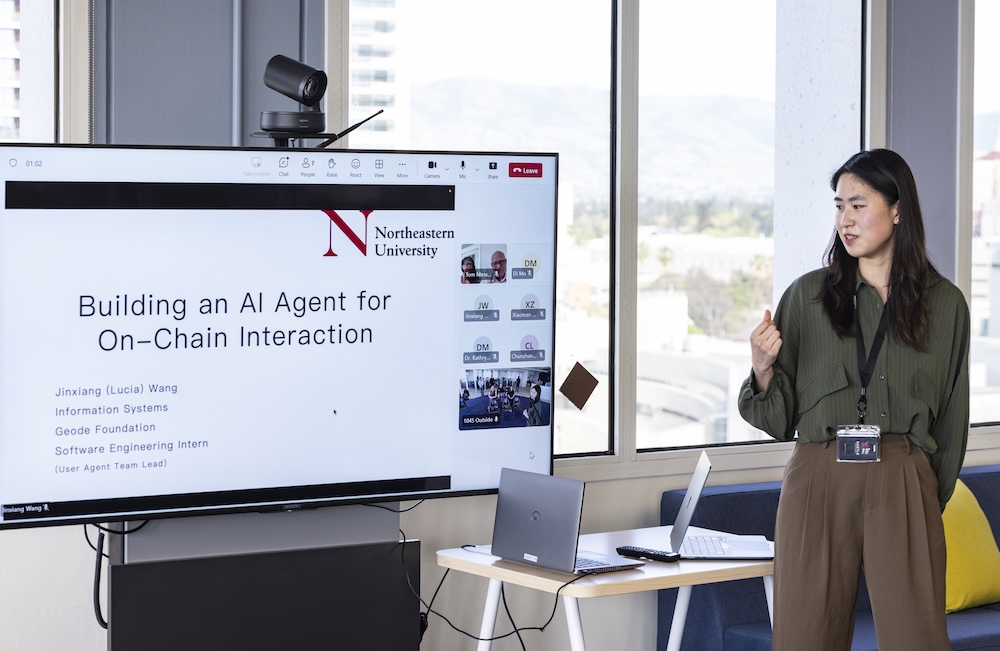
Turning Natural Language into Executable Blockchain Actions
Jinxiang (Lucia) Wang’s curriculum vitae boasts a hidden golden nugget. It’s not her lengthy portfolio of technical projects showcasing practical, hands-on applications of software engineering, data science, and cloud development. And it’s not her leadership roles either, though she served as the 2025 President of the College of Engineering Student Council and is the current Student Leader for the Google Developers Group on campus.
No, it’s her bachelor’s degree in nursing science, and her unexpected pivot to earn a master’s degree in computer science. Moreover: it’s why.
“I had initially planned to pursue nursing in graduate school,” Wang recalls. “It wasn’t until my junior year, when my grandmother was diagnosed with late-stage pancreatic cancer, that I started to consider how a data-centric approach to patient care could have resulted in earlier detection.”
In her shift from clinical practice to healthcare technology development, Wang was quick to bolster her technical acumen by capitalizing on Northeastern’s structured research support and proximity to the Silicon Valley tech hub. Now, in the final year of her program, she has turned her attention to the blockchain as a Software Engineering Intern and User Agent Team Lead at The Geode Foundation, a non-profit blockchain platform that facilitates equitable access to economic independence through community-driven resources.
“Blockchain is obviously very different from healthcare tech, but, in a way, it’s also fundamentally similar,” she explains. “They both empower users with autonomy to take control of their own lives, whether through their health or their finances.”
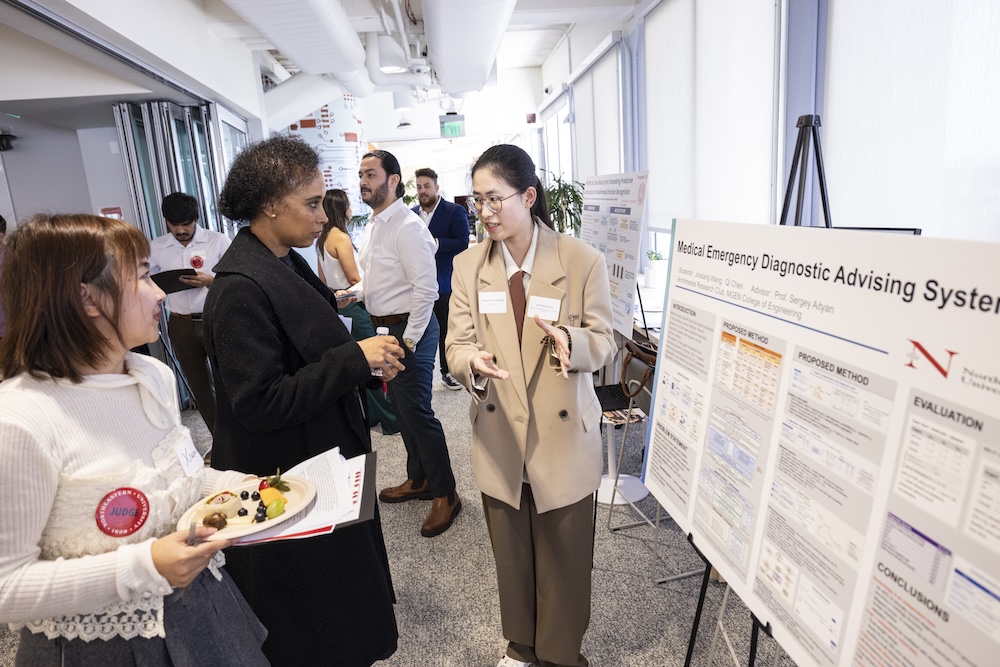
Jinxiang explains her project that was selected for the Spring 2026 Research and Innovation Showcase at Northeastern’s Silicon Valley campus.
De-barriers in Decentralization
Blockchain was designed to remove the reliance on banks for controlling transactions and access to funds. Information for transactions is stored in groups called blocks that are linked together via a chain of encrypted records, adding a layer of cryptography to the currency, i.e., cryptocurrency. The information is stored publicly in a decentralized system, and each blockchain network supports its own ecosystem of tokens and applications.
There are advantages and disadvantages to cryptocurrencies — but we’re here for the science. One of the overarching research challenges is how to add a layer of accessibility to a highly technical, globally dispersed platform that was built by developers, for developers.
Some blockchain networks, like Bitcoin, simply allow users to send and receive currency. Smart Contract Networks, like Ethereum, add conditional logic so that transactions only take place if specified conditions, unique to each contract, are met. On-chain applications, also called decentralized applications (dApps), are user-facing interfaces for smart contracts, but they’re notoriously technical, making adoption by the public difficult.
“We set out to change that,” says Wang. “When I was applying for internships, I was curious about how decentralization changes the way systems are designed. Geode’s combination of a decentralized system with a real product environment stood out to me.”
So how do you abstract away the complexity of interacting with dApps for adoption by non-technical users? You guessed it: Large Language Models (LLMs).
Developer mode: off
Early LLMs were primarily used to generate text because they lacked a reliable way to turn natural language into executable actions. Then, in late 2024, Anthropic introduced the Model Context Protocol (MCP) to let agents connect to external tools. Wang’s team built a conversational artificial intelligence agent that integrates MCP with Application Programming Interfaces supporting predefined on-chain actions and smart contract workflows.
While the user interacts with a chatbot, the agent orchestrates fixed workflows under the hood. This deterministic pipeline keeps the system predictable and reliable by avoiding the risks associated with dynamically generated actions. Unconstrained generation can introduce malformed payloads, inconsistent execution paths, and unintended side effects. Restricting execution to predefined tool interfaces improves safety, reproducibility, and operational stability.
Just as importantly, the architecture separates the AI layer from sensitive operations, so that private keys never pass through the AI model, the MCP, or backend agent services. All on-chain actions still require explicit user-side wallet approval and transaction signing, so there’s no added risk to user security — no small matter when it comes to protecting financial transactions.
“In the beginning, I was nervous about leading a team of developers through a domain that was unfamiliar to me,” she says. “But I learned by doing, asking questions, testing ideas, and iterating quickly. Over time, I realized that those uncomfortable moments were actually when I learned the most. Real-world systems are ambiguous — you have to lean into the discomfort.”
Into the real world with real solutions
The agent is already live on Geode’s portal for account creation, on-chain surveys, and responding to user inquiries. Wang’s team is developing more robust user profiles that will enhance agent utility with personalized, context-aware actions, but there are still challenges to overcome.
“Financial transactions on the blockchain are irreversible, you can’t introduce a model into that ecosystem without a clear and safe structure,” she explains. “Remote debugging in distributed systems causes a lot of back-and-forth that needs structured logs with reproducible steps, as well as standardized setups with changes validated in deployment-like environments.”
Wang recently presented her research at Northeastern’s Silicon Valley Campus Co-op Showcase. The Co-op program provides academic credit for internships while offering resources to support and prepare students for their experiences in work settings. Wang attributes the program to much of her development in strategic problem solving, effective workplace collaborations, and team leadership in production environments, but for Wang, the real transformation was in graduating from a student mindset.
“The biggest shift for me was seeing first-hand that, even if your code works, it’s useless if your users can’t navigate an overly complex system design. I want to design systems that are not just correct, but also intuitive and user-friendly,” she says. “Now I’m thinking like an engineer.”