Ilmi Yoon, Director of Computing Programs, Wants Each Student to Find Their ‘Aha’ Moment
January 21, 2025

Ilmi Yoon wears many hats: computer scientist, instructor, researcher, the newest director of computing programs in the Khoury College of Computer Sciences at Northeastern’s Silicon Valley campus. But her favorite hat is for gardening.
“At the Silicon Valley campus, I see amazing students coming from (all over) that are super smart, that have amazing talent. They are creating powerful potentials here, and I really want them to blossom fully,” Yoon said. “I like to be a kind of gardener. I love gardening in my home too, and I have amazing potential (in the form of these) small plants on my Northeastern (campus).”
Yoon joined Northeastern in Silicon Valley in August of 2024. She is an experienced educator with 24 years at San Francisco State University as a professor of computer science under her belt, and an expert computer scientist whose work explores how technological innovations like machine learning and human-centered AI intersect with societal benefits like inclusivity and accessibility.
But Yoon believes her greatest strength is her ability to pull teams together, connecting people with a variety of talents and nurturing students to grow into their own unique capabilities – and she is excited to see what she can grow here at Northeastern. Her colleagues are enthusiastic about the impact she’s made thus far.
“Ilmi’s leadership is marked by an unwavering commitment to student success, entrepreneurial thinking, and the ability to create and nurture thriving R&D communities,” says Caroline Simard, regional dean. “Her role is a key position, both leading the academic faculty of Khoury College and working within our campus leadership team to shape strategy. She has already built significant momentum on the Silicon Valley campus, including leading the launch of the new MS in Artificial Intelligence program.”
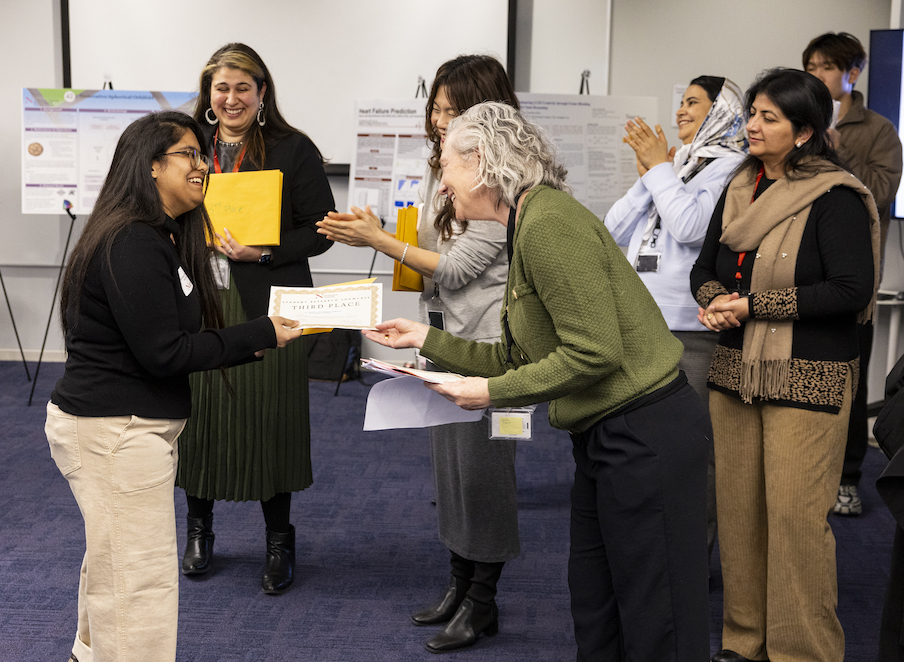
Yoon and Regional Dean Caroline Simard presenting an award to a student researcher
Finding her own professional calling through perseverance
Yoon’s journey into computer science began in 1988 at Yonsei University in South Korea, and it had a rocky start.
“I hated computer science, big time, for the first two years,” said Yoon, “A lot of knowledge I learned was kind of on top of my brain — it didn’t mean much. But two years in, there was a clicking moment.”
The click happened in a class on automata theory, exploring how high-level programming language gets converted into the machine code that a computer actually runs. Yoon compared finally understanding the way that the code she was writing became a functional computer program to the moment in the movie The Miracle Worker when Deaf/blind woman Helen Keller realizes that the shapes her teacher has been making on her palms are words, representing real things.
“I cried when I was watching the movie,” Yoon said. “I also felt that happen to me.”
Yoon grew to love computer science very quickly after that, and moved to California in 1994 to pursue first a Master’s in computer science, and then a Ph.D. in computer graphics, both at the University of Southern California. Studying in the Computer Graphics and Immersive Technologies (CGIT) Laboratory, she honed an interest in and aptitude for immersive technologies like human-centered AI that persists to this day.
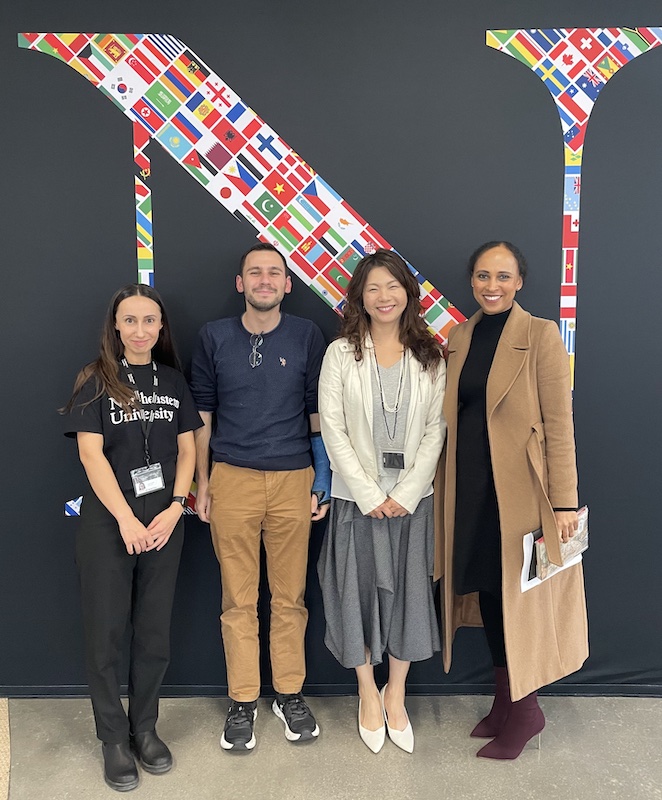
Yoon during International Education Week with, from left: Huayra Hnatko, Global Learner Support Specialist; Nadim Saad, Assistant Teaching Professor with Khoury College of Computing Sciences; and Seblewongel Ayalew, Associate Director of Operations, Silicon Valley.
Supporting each individual’s pathway into computer science
When she joined San Francisco State as a professor at the beginning of 2001, she made a point of using her own transformative “aha” moment to inform her approach to teaching. Her goal is to set up all the conditions for her students’ lightbulbs to come on, and to keep them from getting discouraged before they do.
“Those moments help me to be more supportive of our students and wait for them to figure it out, and then when I see their clicking moments, that’s so rewarding,” she said. “Until that moment comes, you need to be patient (with) yourself, stay strong.”
It’s also important to Yoon that everyone has an opportunity to realize they love computer science. To that end, she founded San Francisco State’s Promoting Inclusivity in Computing (or PINC) program in 2017. Over the next seven years, what began as a computing applications minor for students in life sciences majors grew to include students from a wide variety of backgrounds, as well as certificate programs, summer coding programs, and a scholarship. Under Yoon’s direction, the program received grants from both the NSF (PI) and Genetech (co-PI), and it has served nearly 600 students to date.
This experience has a direct connection to Northeastern in Silicon Valley’s Computer Science and Data Science Align programs, which allow students without a technical background to complete a short series of bridge courses and then transition into the standard master’s curriculum of their field.
Connecting academic research with educational outcomes
At the same time that she was launching the PINC program, Yoon was conducting multiple accessibility research projects. Two long-term efforts that have been particularly meaningful to her have been her work on online video accessibility for blind users, and Nurse Town, a virtual nurse training program designed to lessen the burden of in-person training by offering equally effective digital options. Like with her teaching work, enabling others to access moments of meaningful learning is a significant driver in Yoon’s research.
“It is very rewarding when you are working on your passion project and you can impact other people’s lives. (It is an) amazing way of doing research, and doing your work,” Yoon said.
Yoon also spent her two dozen years at San Francisco State learning something less tangible: how to play to her own unique strengths. Instead of diving deeply and thoroughly into a single topic like her colleagues often preferred to, Yoon felt drawn to wide-reaching, interdisciplinary methods, bringing together a variety of experts to create projects that expanded beyond any one individual’s area of expertise.
“I’m not a very typical professor…I’m actually better (at) going broad and making a team (out of) a lot of good faculty who are doing their jobs well. I’m like the glue to connect them” Yoon said. Whether she was establishing a new computer science education program for underserved students, or working with blind users to develop automatic audio description services for videos, “I needed to focus on my strengths which make me unique, and make a team of unique people working together.”
And so, when Yoon — full of ideas for improving access to computer science education, and passionate about the power of creating connections — got the call from Northeastern University, it was a no-brainer to take on the new challenge.
“The way Northeastern has been growing is very, very unusual as a university system – it’s almost like a startup company, with a lot of support,” she said. “It was something I wanted to explore.”
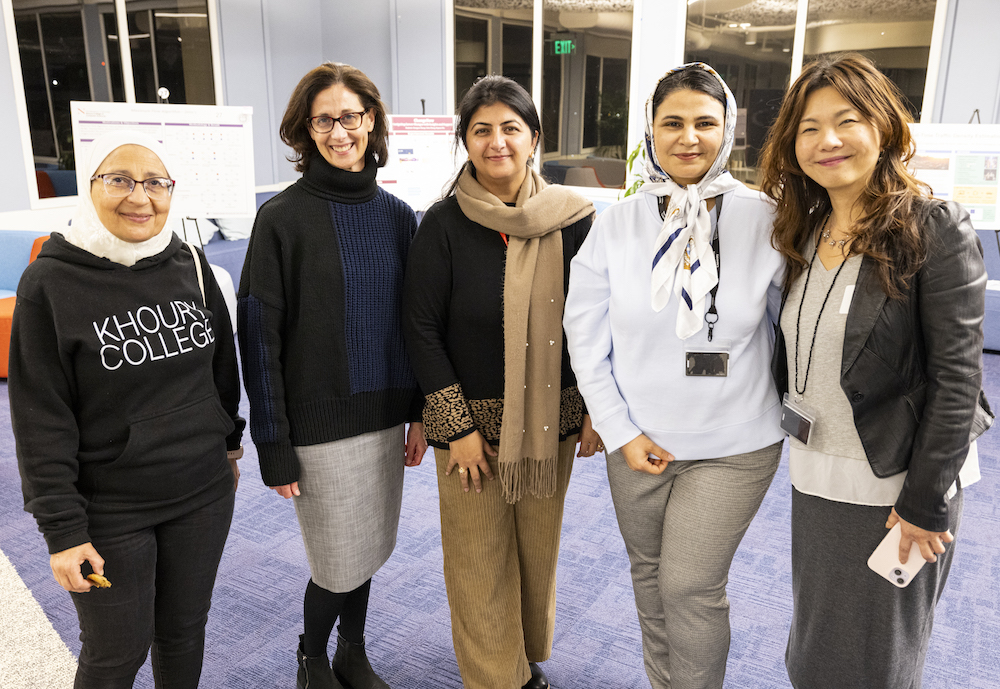
Yoon with members of the Khoury faculty team, from left: Lama Hamandi, Associate Teaching Professor in Silicon Valley; Sami Rollins, Director of Graduate Computing Programs & Teaching Professor in Oakland; Tehmina Amjad, Associate Teaching Professor in Silicon Valley; and Akram Bayat, Assistant Teaching Professor in Silicon Valley.
Building momentum around student research and other moments that ‘click’
Upon joining Northeastern in Silicon Valley at the beginning of the fall 2024 semester, one of the first projects Yoon felt drawn to was the semesterly Student Research Showcase. She jumped in with both feet, collaborating with associate director of Career Development and experiential learning Natasha Odama to establish new funding for awards to encourage and recognize student participation, and to recruit a broad panel of guest and student judges. She also mentored three teams herself.
“I think it’s really critical that students are not taking just the courses; they are doing research, and that research is driven by their passion,” Yoon said. “Seeing what they create makes me proud of my own job, too; that I am serving these amazing students.”
The efforts from Yoon and Odama were evident in the success of the event. “Last term’s Research Showcase was an absolute highlight for our campus,” said Karen Chang Pryor, director of Student Services. “It was so incredible to see our students in action and getting a chance to proudly share the culmination of all their hard work. Working in Student Services, I get to see students through their campus involvement and Student Interest Groups, so to hear about their research was like uncovering a whole new part of their lives. The 10th floor was buzzing.”
Chang Pryor’s mother, Janet Chang-Pryor, also attended the event as part of the panel of industry judges alongside representatives from partner companies large and small. “My mom spent her whole career working in the Valley at major tech firms like Cisco Systems, so it was really cool to have her on campus as a judge for the event. She was so impressed by the quality of the research and the potential practical applications of these projects. I am excited to see how this event grows in the future!”
Yoon is planning to keep building on this success. As her roots on campus deepen, she is excited to connect with more members of the Northeastern in Silicon Valley community, learn their particular strengths, and enable them to connect in new ways.
“I believe in the power of diversity and the strength of uniqueness,” Yoon said. “When people with unique skills (work) as a team, you can do amazing things.”

Yoon looks on proudly after handing student Yue Yu the second place award for her team’s project, “Deep Learning for Heart Failure Prediction”