2024 Graduate Research Topics Include Generative AI for Small Businesses, and Machine Learning for Healthcare
August 22, 2024
Article by Madelaine Millar. Photographs by Greer Rivera.
For LeAnn Mendoza and Varun Kabra, April 15, 2024 was an evening of celebration.
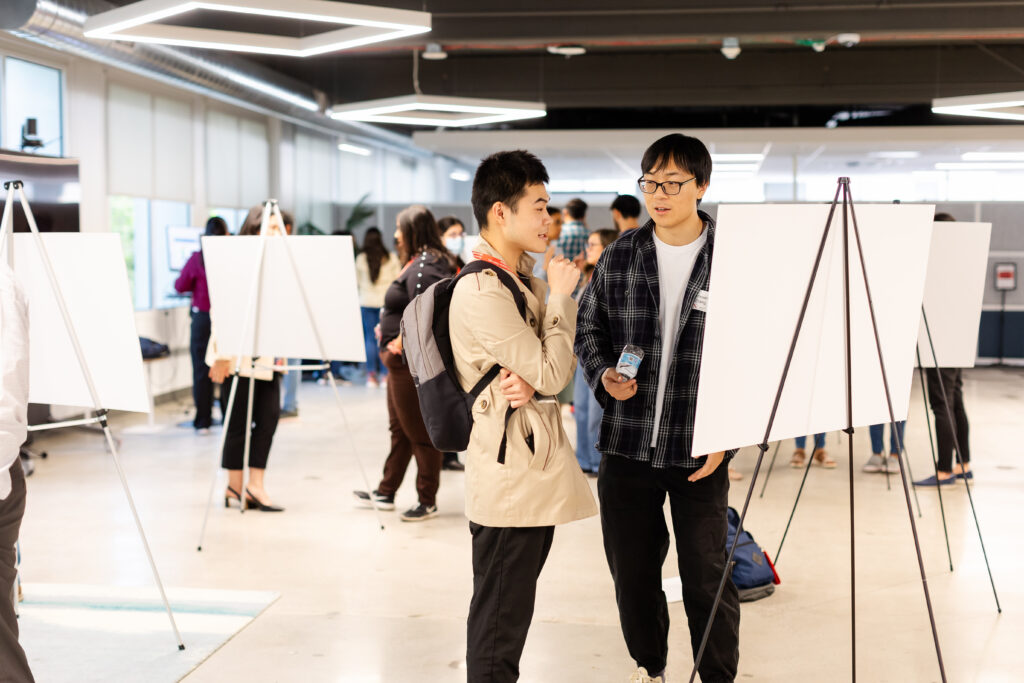
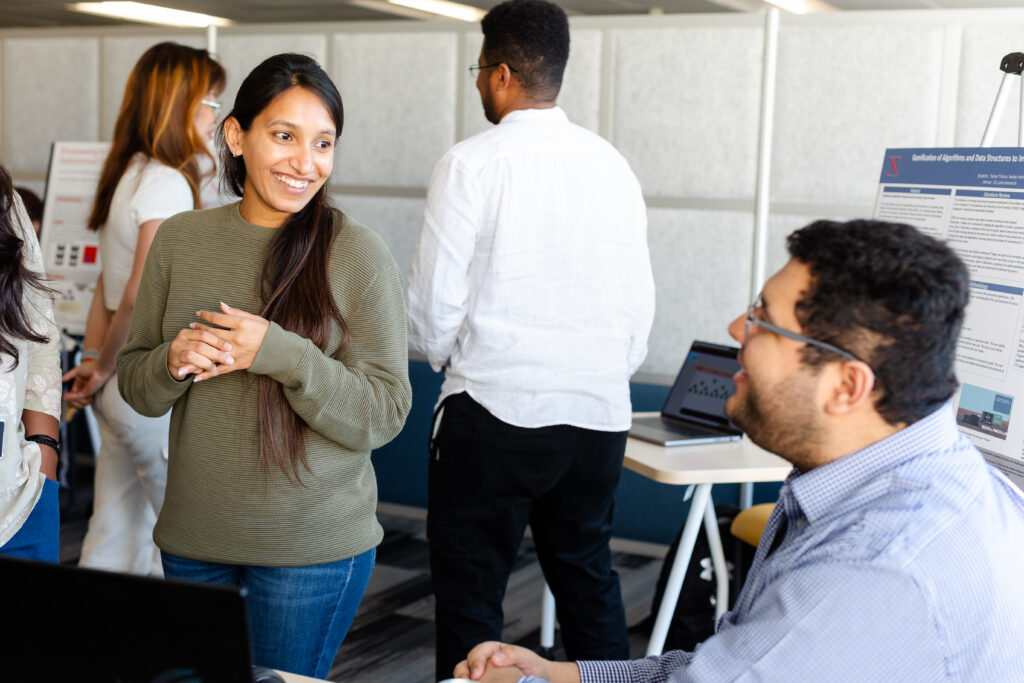
For months, both students had been working on independent research projects – Mendoza (MS in Data Science, class of ‘24), on a no-code chatbot to help her and other small business owners like her to answer Instagram DMs, and Kabra (MS in Data Science, class of ‘24), on an algorithm to diagnose some 800 different diseases. And that evening, Mendoza and Kabra – along with 18 of their peers – presented their research to faculty, alumni, industry community members, potential employers, and their fellow students at Northeastern in Silicon Valley’s first annual student showcase.
“I loved the experience. It was the very first time Northeastern in Silicon Valley had this kind of a showcase at this scale, and I think it just changed the game,” said Kabra. “It gave us a platform to showcase what our research was about, to connect with people from the industry, and to come up in front of the faculty so they know what kind of research is going on in the university. And I really enjoyed myself.”
Read on to find out more about what inspired Mendoza and Kabra’s work, the challenges they tackled, and how it felt to show their completed research to the world.
Few-shot chatbots for micro-businesses
Like a lot of people, LeAnn Mendoza spent 2020 trying something new. The bakery she launched as a hobby took off, offering Filipino-American desserts like yema cookies and chocoflan to a growing number of customers around San Diego. By 2024, Haliya Bakery’s success had grown beyond what Mendoza had time to handle while also pursuing a master’s degree, even with her family’s support.
But Mendoza is one smart cookie. She knew data science could help her out – and maybe help other small business owners, too.
“I was getting a lot of messages on Instagram like ‘how do I place an order?’ or ‘what flavors do you have?’ – these simple questions that have a standard answer,” Mendoza said. “A lot of people don’t have a technical background in coding, so I wanted to devise some sort of no code solution for small business owners to develop their own chat bots.”

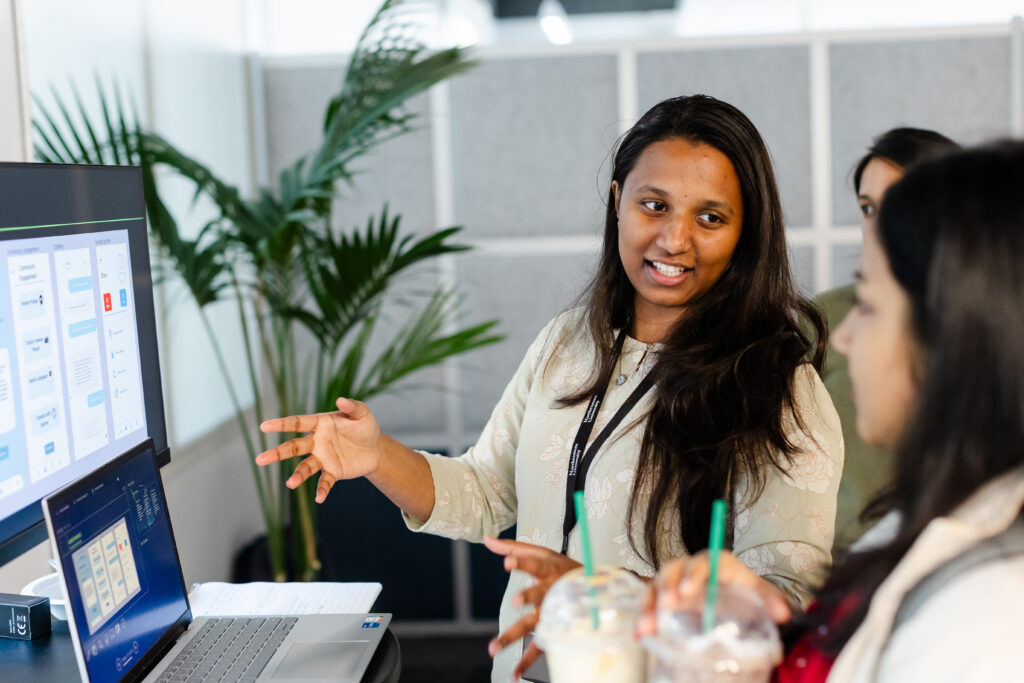
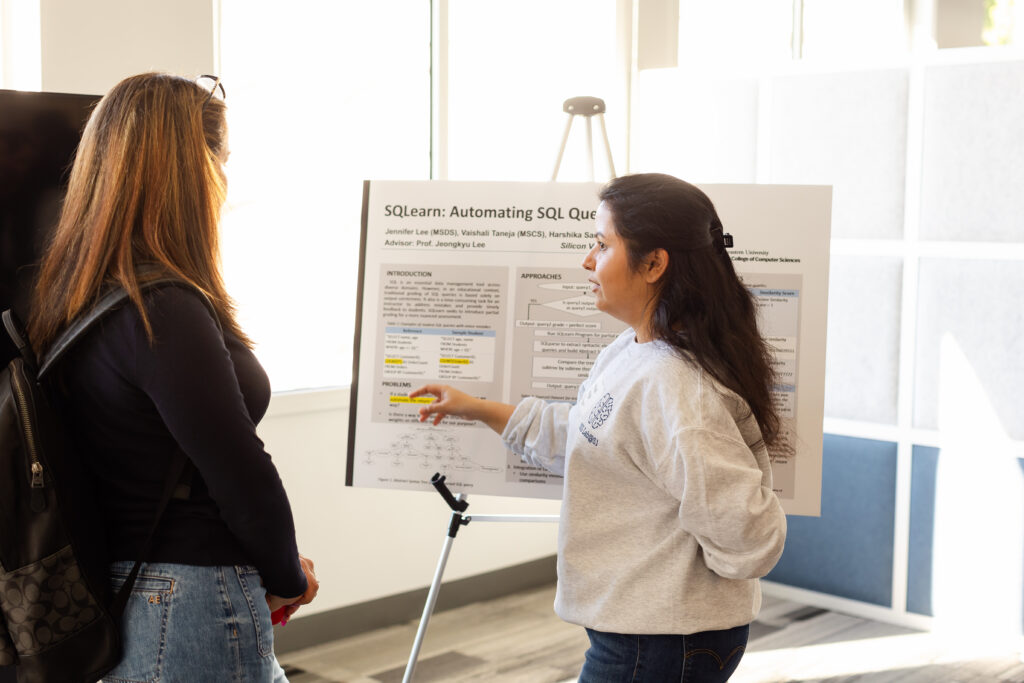
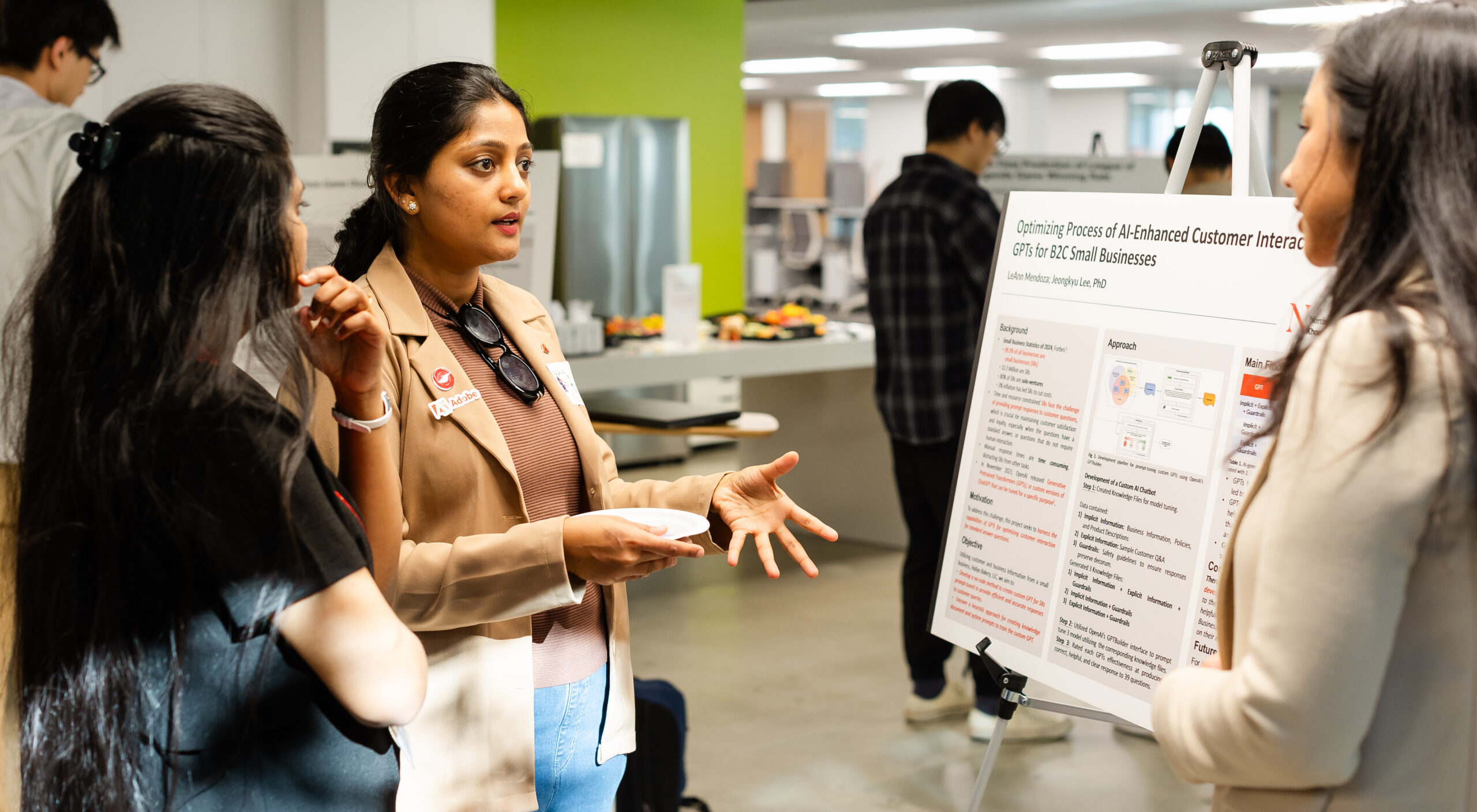
LeAnn Mendoza discusses her research with Thomas Neubert, CEO of the Transatlantic AI eXchange
With support from Professor Jeongkyu Lee, Mendoza tested zero-shot learning and few-shot learning techniques with a variety of APIs and generative AI tools. The most pressing question was, how much information did the bot need to be able to return correct answers for untested queries? Too much, and the tool would become unwieldy for small business owners without technical backgrounds; too little, and the chatbot could return answers that were illegible, incorrect, or even harmful.
The moment of truth came when Mendoza showed her chatbot to her family. Her parents had been helping her stay on top of Haliya Bakery’s Instagram DMs. As non-native English speakers, the LLM-produced output empowered them to quickly and confidently formulate responses.
“When I showed this project to my dad, he was so excited about it,” Mendoza said. “I got on a Zoom call with my family and I showed them how to use it; we’d ask it a question and then we’d all watch together what it would say. It was cool, seeing this chatbot work.”
Part of what made the moment so rewarding for Mendoza is the fact that she wouldn’t have imagined herself capable of creating anything like a generative AI chatbot when she first founded Haliya Bakery. Her undergraduate degree is in bioengineering, and she didn’t discover her passion for data science until she was working at an ophthalmology clinic after graduation. So when she found the Align program – a three-year path to a master’s degree in computer science, for students from all undergraduate backgrounds – she seized the opportunity with both hands.
“I was really interested in pursuing it as a career, but at that time, I didn’t have any academic foundation in data science,” Mendoza said. “I felt so inspired to be in the Silicon Valley campus, because a lot of the students are Align students. Thinking about how people have made the jump from their previous non-technical careers to this research showcase, showing things that they worked on and all that they’ve learned – that’s just so amazing.”
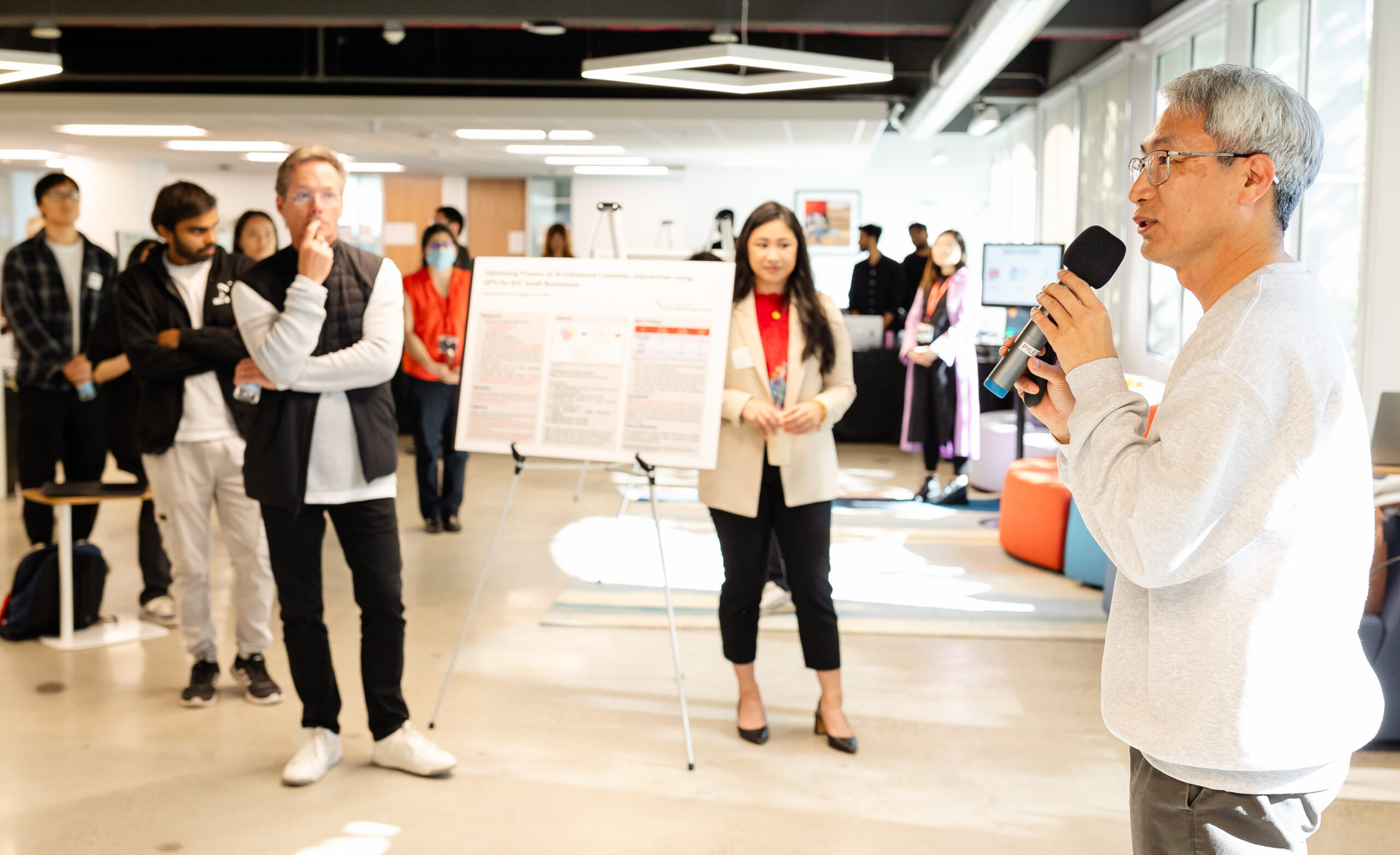
Jeongkyu Lee, Teaching Professor for the Khoury College of Computer Sciences at the Silicon Valley campus and frequent graduate research advisor, addressing attendees
Now equipped with all the tools, knowledge, and network she needs, Mendoza is excited to build out more tools for small business owners to make the most of their data. For example, she wants to know whether the data collected when businesses take orders through free platforms like Google Forms could be quickly and easily leveraged to inform business decisions, even if owners can’t afford additional analytics tools.
“I realized through this project and these research experiences at Northeastern in Silicon Valley that I really enjoy the process of solving business problems using data and data science,” Mendoza said. “Every company is a data company; every business can benefit from making data-driven insights.”
Predictive diagnosis
Varun Kabra’s research project began with a stomach ache.
“I couldn’t book an appointment with my doctor because no slots were available,” Kabra said. “When I Googled it, it just gave me really bad results, saying that it might be my last day in the world. And I thought no, this is not right – I should do something about it.”
What Kabra wanted was a quick, user-friendly way to diagnose himself, so he could begin to manage his pain effectively, immediately. Since he had previous experience working with machine learning algorithms to identify and categorize brain tumors with the Multimedia Information Group (MIG) – and a personal passion for predictive analytics – he decided to create an algorithmic tool to process natural language notes on a patient’s symptoms and return a clear, accurate diagnosis.
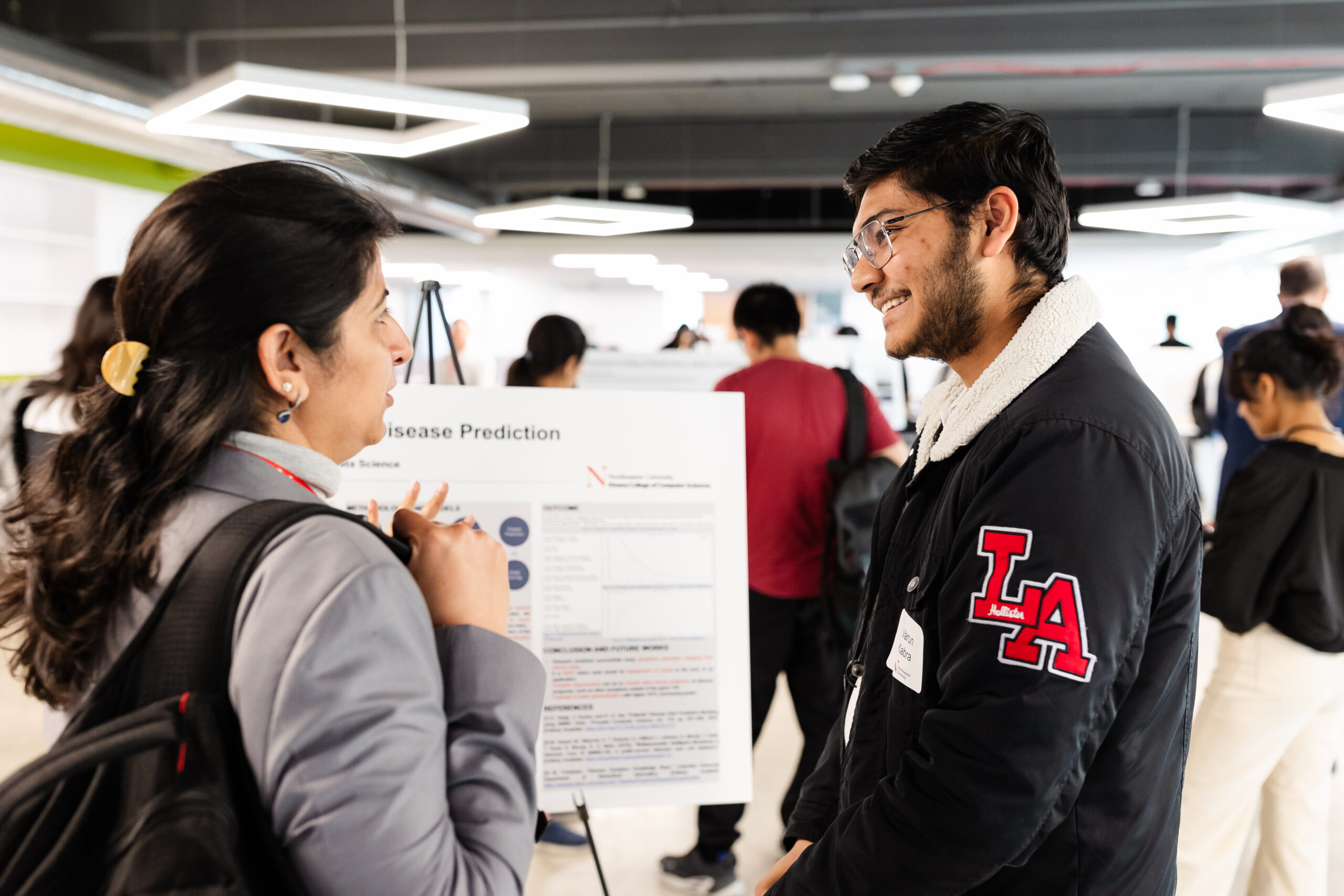
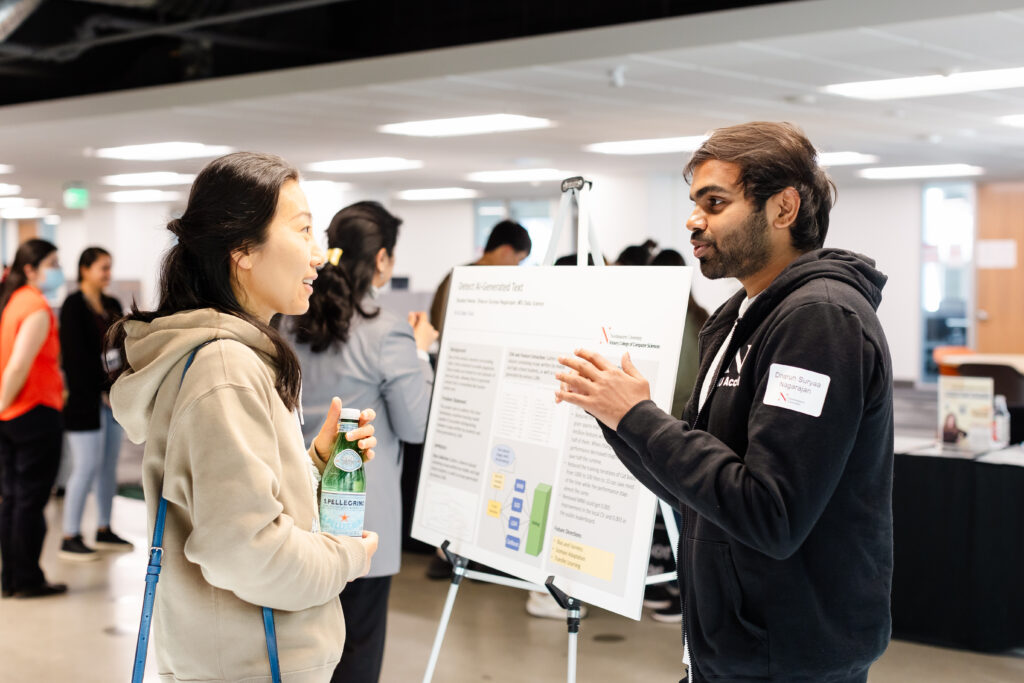
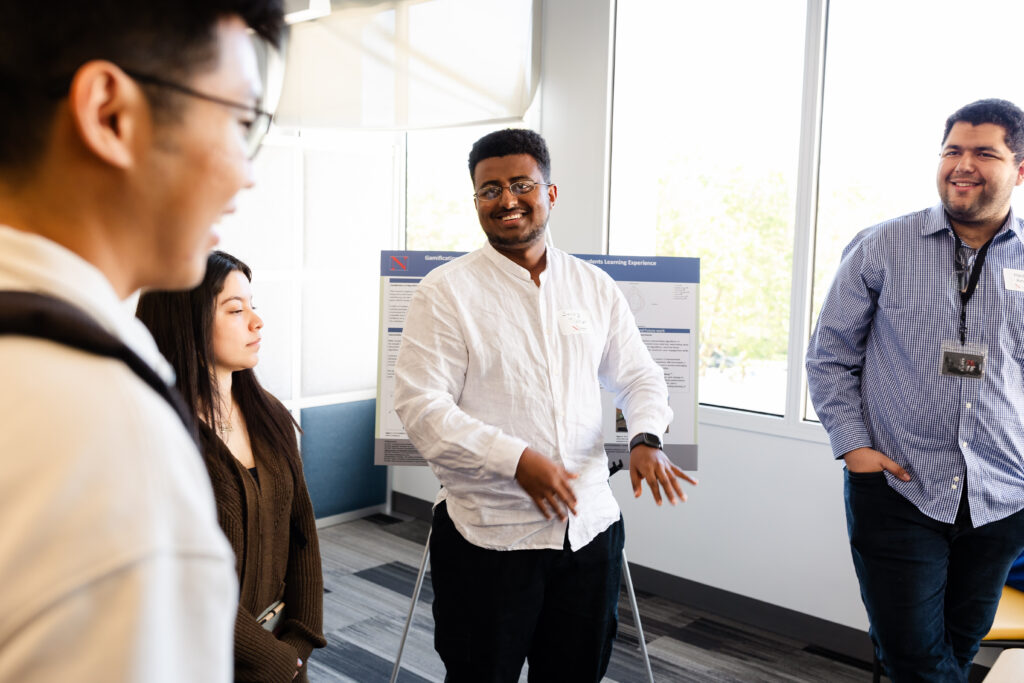
Varun Kabra discussing his research on applying machine learning to diagnosing disease
With support and sponsorship from Professor Lee and Northeastern in Silicon Valley, Kabra was granted access to a public data set of 4 million patient records he could use to train his models. The enormous data set proved to be a blessing and a curse; Kabra was forced to get creative in order to process it, even with the Silicon Valley campus’s significant local computing power. This computing challenge was furthered by his choice to prioritize accuracy by running each query through four different models, in the same way a doctor might seek a second opinion to confirm a diagnosis.
On the flip side, the volume of data also let him create a broadly applicable tool that could evaluate 500 symptoms to diagnose 800 diseases, ranging from malaria to cancer. Kabra continued to refine until his tool could return diagnoses with 93 percent accuracy.
“I think that is what gets to me: seeing those predictions accurately coming up. That is what makes me enjoy what I do,” Kabra said.
Now, Kabra wants to refine his model even further. One option he’s interested in is expanding his data set globally, so geographic factors won’t impact his accuracy rates. Since he graduated in May though, getting access to controlled patient records and the computing power to process them is tougher than when he was still a student. So, inspired by the booming interest from the industry just outside his classroom door, Kabra is also considering ways to incorporate generative AI into his predictive healthcare tool.
“The reason why I picked the Silicon Valley campus is because of the location, and I think it was one of the best decisions to come to San Jose. There are a lot of conferences in the area, and I made a lot of connections in the industry,” Kabra said. “Being in the Bay Area, the hub of the tech industry, definitely gave me a lot of opportunity.”
Graduate research and the Silicon Valley campus
Mendoza and Kabra both relied on a wide variety of Northeastern in Silicon Valley supports to complete their ambitious projects. Some – like MIG or Align – were formal programs, and some – like the Silicon Valley campus’s ability to spotlight graduate research, thanks to its selective focus on just eight master’s programs – were more nebulous. Other supporters were people like Natasha Odama, associate director of career development and experiential learning at Northeastern in Silicon Valley and the organizer of the showcase.
“It was so great to see the students excited about showcasing their work; being able to give them the opportunity to do that was important to me,” Odama said. “We want to expose our students to as much as we can in Silicon Valley. We want them to have the presentation skills and the confidence to be able to show what they’ve been doing in a meaningful way.”

Natasha Odama, Associate Director of Career Development and Experiential Learning (left), and Valerie Cruz, Administrative Coordinator
Northeastern in Silicon Valley is located in downtown San Jose specifically so that its students and the cutting edge of the tech industry can come into contact with each other, frequently and naturally. Odama believes in making the most of their location, and she works to ensure recruiters and alumni interested in hiring fresh talent can – and do – stop by events like the research showcase to see what Northeastern’s students are creating.
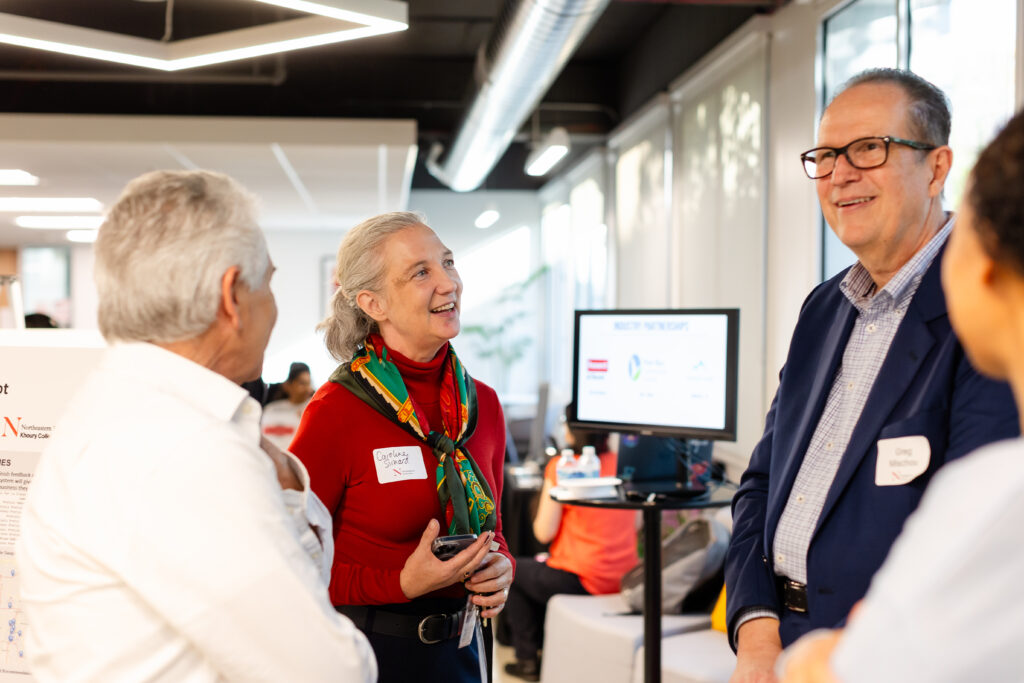
“There was an industry professional actively searching for talent, engaging with people whose projects caught his interest. Alumni also attended, and were genuinely impressed by the students’ work,” Odama said. “It was a very positive event, full of energy and meaningful conversations.”
While the support of the Silicon Valley campus’s staff, faculty, and industry partners is important, what Mendoza found most special about the student showcase was the chance it gave her to celebrate her accomplishments with her fellow students.
“Everyone on the campus really has this pulse,” Mendoza said. “Everyone is on some sort of trajectory; everyone’s working on something exceptional and cool; everyone’s very career-focused, but in a way where we’re all very supportive of each other. Having showcases and seeing everyone on display, talking about the things that they’ve worked on throughout the semester, is such a cool thing to see.”
The spring research showcase is an annual event. Students can contact Natasha Odama at [email protected] to learn about getting involved in 2025.