


“AI for Good” Hackathons Inspire Students Over Summer Break
January 9, 2025
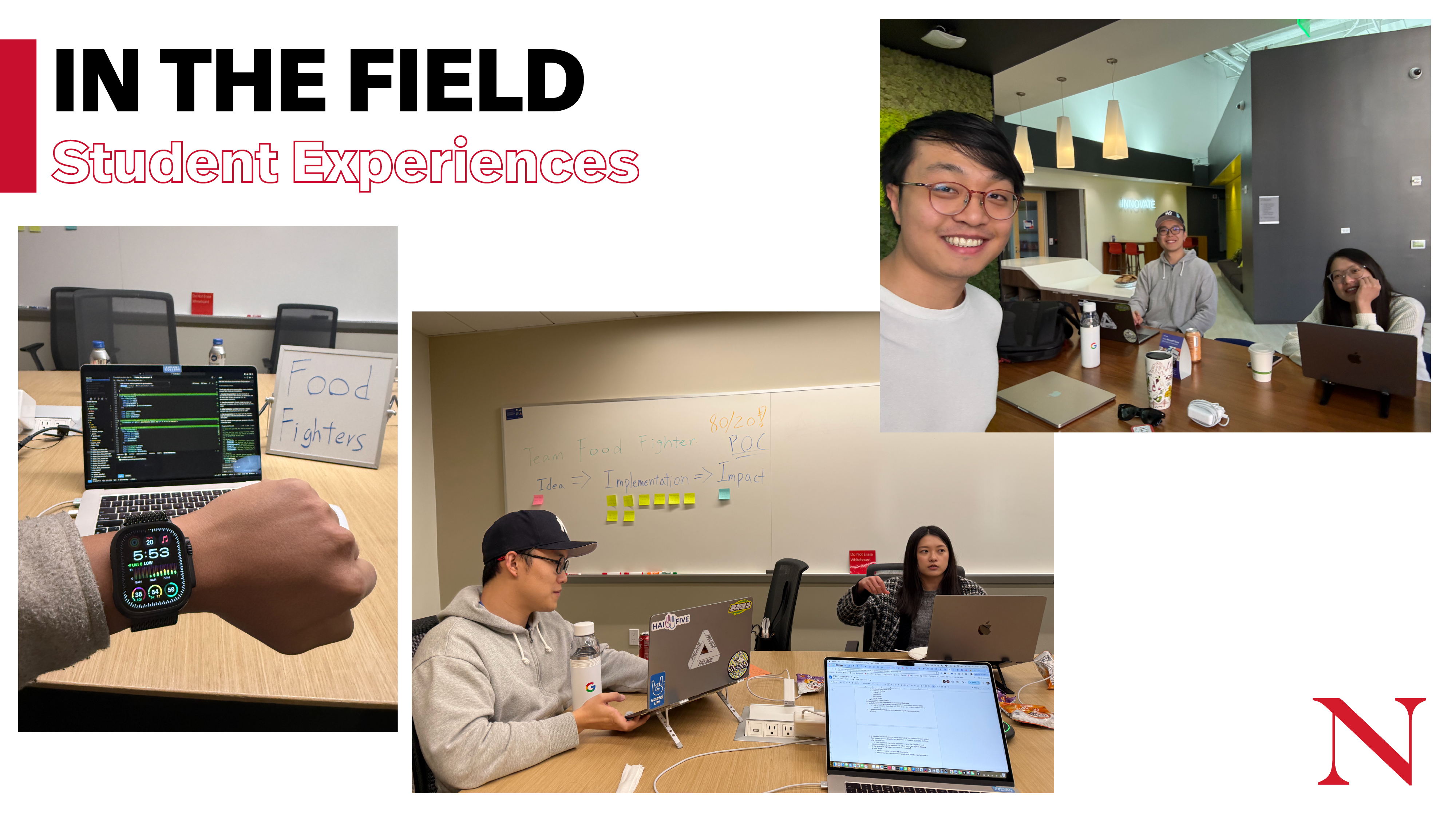
When Computer Science Master’s students Aaron (Chieh-Han) Chen, Amy (Hsin-Yao) Huang, Richard (Xinrui) Yi, and Songting Yang went looking for a hackathon they could participate in together over the summer break, they found not one, but three that were focused on harnessing AI’s potential for good.
“AI for good” hackathons seem to be on the rise, a sign that there’s growing interest, including from the tech industry, in ensuring that the future of AI is responsible and human-centered. Chen agrees, “We’re starting to see a trend.”
He and his friends signed up for all three competitions, choosing to explore and adapt one innovative idea to the requirements of each one. “Our approach was to have multiple entries with one project, but expand on it each time,” he explained.
Home cooked meals from what’s in your fridge
The idea — using AI to reduce food waste — led them to build an app for helping people create personalized meals from what’s literally in their fridge. Users upload a photo of the contents of their fridge, and the AI-powered app (which they named BiteWise) generates a recipe idea based on that and their previously inputted dietary needs, restrictions, and preferences.
The idea for BiteWise was partly inspired by personal experience, especially for Yi. “Sometimes, I struggle with deciding what to cook,” he said. “One motivation for developing the app was to help everyone enjoy delicious home-cooked meals.”
The other, more urgent inspiration was the global problem of food waste. “We waste over 1 billion meals every day, with most of the waste happening in our own homes,” Chen said. Food waste has significant environmental, economic, and ethical impact, being a contributing factor to climate change.
Opportunities for hand-on learning
While BiteWise didn’t win any prizes, it advanced to the second stage of the 2024 TEDAI hackathon, putting their team among the 39 selected to “hack” in person at the Microsoft Reactor in San Francisco.
But their biggest achievements are the skills and experience they gained from tackling a real-world problem and working as a team to develop a tangible solution in a limited time frame.
To bring their concept to life, the four students had to learn and adapt to meet the technical requirements of each competition — in the case of the TEDAI Hackathon, they had to do it on the spot. “We really were trying to dive into the rubric and what they were looking for. We went through item by item and tried to think of ideas to expand upon our prototype,” Chen said.
But they didn’t just hone their technical abilities in the process; they also sharpened their interpersonal skills. For one, they had to learn to work together as a team, dividing the development tasks according to their unique skills and expertise. “Each of us has a diverse background and that helped,” Chen explained.

Aaron, Richard, and Amy at TEDAI 2024 hackathon in San Francisco
Chen, whose experience is in product management, led the integration of AI models into the app. Huang, who previously worked as a data analyst, crafted prompts to incorporate various inputs and fixed a critical bug in the AI model’s responses. Yang, whose background is in business information technology, designed the user interface. Yi, a former civil engineer, managed user input and the backend database. The four met in the foundational courses of the Align Master’s program, which helps students from non-technical backgrounds transition into tech careers.
“It was great working with a diverse team,” Yang said. “Everyone brought unique perspectives, which helped me learn a lot. It reinforced my understanding of being a software engineer and the importance of collaboration.”
Additionally, they had to pitch their idea in different ways. For the FlutterFlow hackathon, they made a video; for Google’s AI for Good, they created an alpha version of the app and a video walkthrough; for the TEDAI Hackathon, they sent a project proposal in advance of the competition — then further developed and pitched their idea in person. “They send judges to your meeting room and you present to them on the spot. And then the ten teams that advance do a final pitch,” Chen explained.
New experiences and connections
Participating in hackathons also led to new experiences, including sleeping under an office desk and seeing the mayor of San Francisco up close. (Both happened at the TEDAI Hackathon, which went on for 48 hours and was the only in-person event.)
“We couldn’t turn off the light in the meeting room,” Yi explained. “Sleeping under the table was our only option.”
He and Chen were half-awake when the organizers told everyone to clean up their work stations — the mayor of San Francisco, London Breed, was stopping by to say a few words and take a tour of the office. “It was humbling to see that she cared, because we’re just students trying to build something we’re passionate about,” Chen shared.
She wasn’t the only interesting person they got to meet. “We shared a meeting room with five TikTok engineers and saw how they worked together,” Yi said. “They had a really good project for translating music into video for deaf people.”

Teams took over conference rooms at the Microsoft AI Co-Innovation Lab in downtown San Francisco
During a coffee break, the students started a conversation with the engineers that led to finding common ground. “One of them was actually a Husky who graduated from the Boston campus a few months ago,” Chen said.
“To be able to share a seat at the table with all these accomplished engineers, you know, people who have worked on very difficult AI-related projects like Google DeepMind, was definitely a humbling, but also a very exciting and inspiring experience,” he added.
The TEDAI hackathon also exposed the group to numerous creative AI applications to social and environmental challenges, including increasing accessibility for children with autism, helping female victims of domestic violence, and preventing the spread of misinformation.
The winning team — made up of three “really young people,” including two high school students, according Chen — developed a web dashboard to help zookeepers with animal care.
“One of them volunteers at the Oakland Zoo every weekend and noticed that the way zookeepers were keeping track of animals was inefficient and caused a lot of fatalities. They devised a way to use image recognition and computer vision to alert zookeepers if something goes awry,” he said. “They had a very good story, and they even implemented their solution at the actual zoo.”
That aligns with Yang’s biggest takeaways from participating in hackathons this summer: “It’s not about developing fancy stuff, it’s about solving real problems,” she said.