


At “Remarkable Women in AI”, Industry Leaders Look to the Future
October 4, 2024
by Meredith Hutcheson
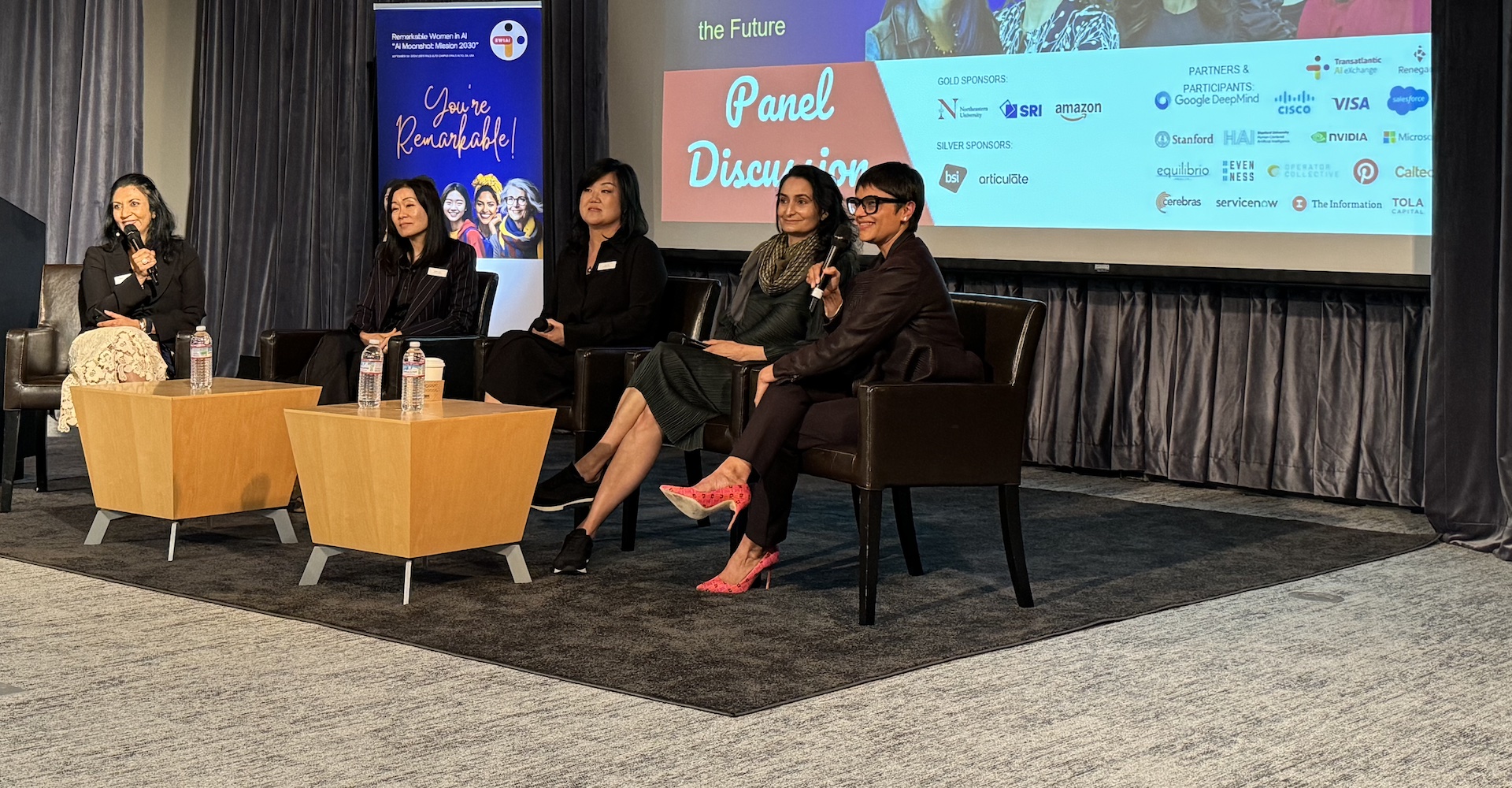
In Palo Alto on September 26, the event space at the SRI campus was filled with a crowd of all ages for the Transatlantic AI Exchange‘s Remarkable Women in AI conference. Business leaders, engineers, researchers from leading institutions, and students from schools throughout the Bay Area chatted and networked. Northeastern students from the event organizing team guided attendees through the space to the auditorium for the half-day program of speakers and panel discussions.
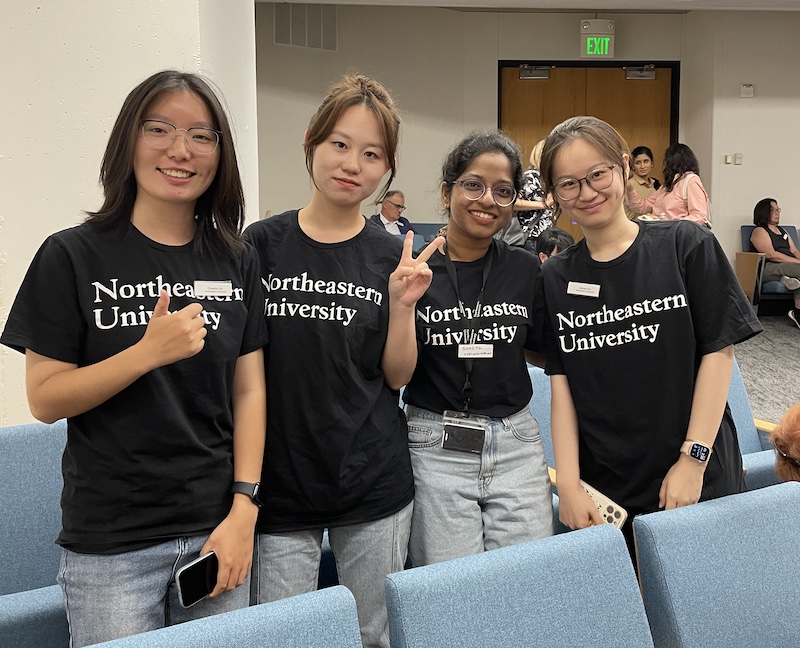
Student volunteers prior to the start of the event
The prevailing atmosphere was one of pragmatic optimism.
Each of the women who took the stage had field experience through multiple previous Silicon Valley technology booms. “The last time I remember there being this much hype about technology was when Netscape came out,” laughed Diane Gonzalez, VP of Technology for Amazon’s finance automation division and 30-year industry veteran. And from that vantage point, the speakers hit an enthusiastic note.
Throughout the day, as discussions touched on topics technical, professional, and even existential, a common message came through. First, that advancements in AI really are set to change how we work, pursue knowledge, and live—in ways that even the most accomplished technologists are still only beginning to understand. And second, that the opportunity that this presents both to society and to individual professionals is enormous and there to be seized.
Beyond LLMs: Neural Operators and scientific simulations
The arrival of keynote speaker Dr. Anima Anandkumar, Bren Professor of Computing at Caltech and a leading figure at the intersection of AI and science, caused a wave of excitement both online and in the room. Dr. Anandkumar is the inventor of Neural Operators, AI models that diverge form standard neural networks in their ability to scale infinitely up and down for “physics-informed learning.”
“There is a wealth of knowledge present in mathematical modeling,” she told the audience, which can fill in for gaps in scientific data. And while large language models can perform impressively within the conditions on which they were trained, in the sciences an AI model needs to “extrapolate to very different conditions than what you observe during training.”
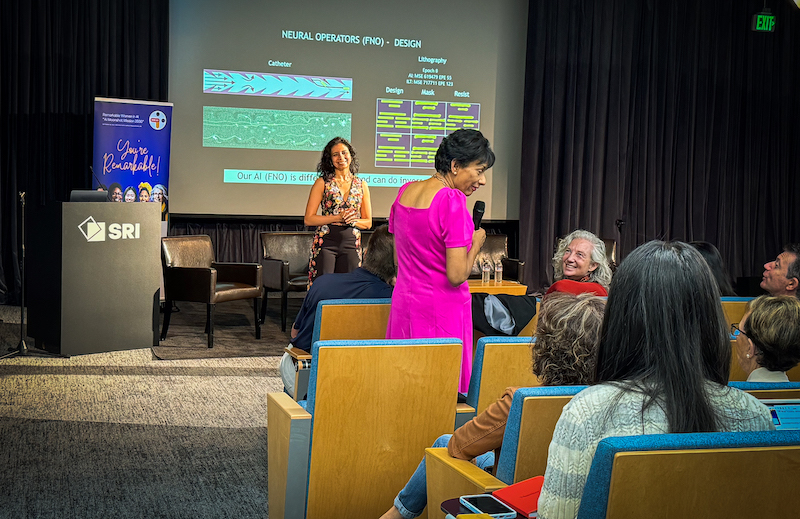
An audience member asks a question following Dr. Anandkumar’s talk
Traditionally, scientific models and predictions have been limited by the human-created models that power them. These require large amounts of compute, run slowly, and have limited scope. The new AI-powered models that Dr. Anandkumar’s lab produces are many times faster and can run on a normal gaming PC.
The applications are wide-ranging, from weather models in use by the NOAA, to engineering new kinds of biomedical devices, to virtually testing solutions for carbon storage.
Dr. Anandkumar’s call to the group was to look forward to the next wave of AI. “The last decade was a bitter lesson,” she said. “Throw in the data; be blind; get models out. Now we’re hitting all kinds of limits, so we need to be clever. Human ingenuity has a long way to go.”
An industry inflection point with many opportunities
A full roster of panel discussions filled the afternoon, and featured experts from industry, academia, and business. All came to the topic with energy and a sense of the possibilities.
Several speakers called out that many of the opportunities from the AI boom will not necessarily be tied to the cutting edge of the emerging technology. As the cost goes down, the ability to integrate AI into a wide range of solutions across industries will open doors. Contrary to prevailing fears about job replacement, the industry insiders saw instead the space to get in on the ground floor.
“The barrier is so low,” said Rama Akkiraju, VP in AI and ML for IT at NVIDIA, addressing the students and early-career professionals in the audience. “I can’t think of a better time. Be bold, be confident, this is the best time to get into it.”
“There’s not a better time than right now,” agreed Dr. Paula Goldman, Chief Ethical and Humane Use Officer at Salesforce. “And here’s why—because things are happening really quickly, there’s a lot of excitement, and there’s also a lot of hype. There are a lot of people out there really confidently talking about things. There are a lot of questions that we don’t have the answer to, and there are a lot of people anointing themselves to give those answers, and it might as well be you.”
“Don’t put yourself in a box. Nothing has been committed yet, nothing has been discovered yet,” said Irina Petrakova-Otto, CTO in AI and Private Capital at Microsoft. “We’re very early in this.”
The business case for diversity
A recurring topic within the discussions was the missed opportunities that arise from tech’s monoculture.
Mallun Yen, Founder and CEO of the venture fund Operator Collective, shared an anecdote about a company her group had invested in. The startup, which operates telehealth services for women going through menopause, had been rejected by multiple other VCs. The reason? “People were questioning whether menopause was a big enough category,” Yen shared, and the whole room erupted in the biggest laugh of the day.
Yen’s investment group doesn’t make funding decisions based on the gender of the founder. But her business model brings together as investors the operators of successful businesses: executives who have been through the startup journey. This group happens to be 90% women, and 40% people of color. And, Yen explains, their investment portfolio is more diverse than the industry norm—including 45% female-founded—because the investors themselves are more diverse. “We all have our own biases, and there’s pattern recognition that happens in venture. When you have people who don’t all look the same, you build stronger companies that way.”
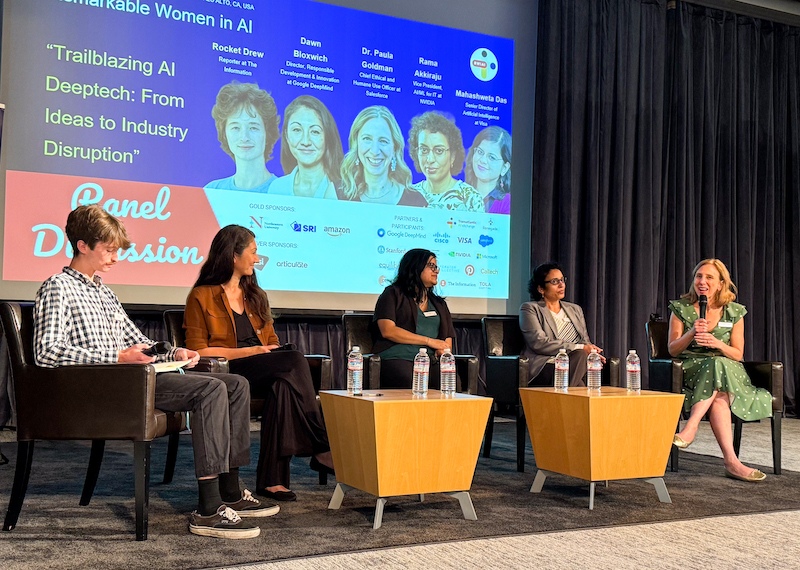
Four expert panels took the stage during the event. Pictured: Rocket Drew (Moderator, The Information), Dawn Bloxwich (DeepMind), Mashweta Das (Visa), Rama Akkiraju (NVIDIA), and Dr. Paula Goldman (Salesforce)
Savita Kini, Director of Product Management for Speech and Video AI at Cisco, also emphasized the importance of understanding diversity at all phases of the development cycle. She pointed to the failure of pulse oximeter devices to function properly on dark skintones, leading to misleading readings and possibly contributing to higher mortality rates for Black COVID-19 patients during the pandemic (New York Times).
“People are getting very obsessed with models,” she said, “but the models themselves are quite useless. They have to sit within a system.” Along with being built with data from diverse populations, outcomes need to be tested against data from diverse populations.
Yakaira Núñez, an AI & Data Research and Insights Executive recently of Salesforce, Capgemini, and Deloitte, sees the industry’s speed race to market as a source of the failure to reach full impact. “The part that people always cuts first—because it takes too much time—is the human research. As we leave people out of the conversation, that’s where the problems with inclusion start. Slow down, and ask why we’re building the thing.”
Dr. Bethany Edmunds, Assistant Dean of Computing Programs for Northeastern in Vancouver and Seattle, agreed that the problems can prevent teams from even realizing the gaps in their knowledge. “Bias throughout all of our systems is problematic,” she said. “From the data that’s being collected, to the problems we’re trying to solve, to the way it’s being interpreted and applied.”
When it came to advice for changing the gender balance in AI, much was said throughout the afternoon on the topic of personal strength and learning to withstand both microaggressions and outright discrimination. But there was also a sense that things were changing for the better, and that by speaking to one another and on behalf of others, women and people of other sidelined groups could continue making strides.
“Having been one of the few women in my field, the thing I missed out on most was networking.” said Dr. Karen Myers, Lab Director at the Artificial Intelligence Center at SRI. “Forums like this are what will allow us to get more women into the field. They’ll feel like there are people like them in the field, and they’ll have people to turn to as they advance. We need many more forums like this.”
And the benefit of this form of networking is not just to the individual, was a theme throughout the remarks of the panelists. The potential to open up entirely new and unexplored areas of innovation by applying different viewpoints is clear. The case for inclusion, as made at the conference, is good ethics, good science, and good business.
Continuing the long push forward for women in the computer sciences
The Transatlantic AI eXchange (TAIX), an organization that facilitates connections between AI industry experts in the U.S. and Europe, presented the conference. It was co-chaired by TAIX Founder and CEO Thomas Neubert, together with Northeastern in Silicon Valley Regional Dean Dr. Caroline Simard.
Remarkable Women in AI was the first event of a planned series. The event’s subtitle “AI Moonshot: Mission 2030” was proposed by Gonzalez, who was on the organizing committee. “We need a rallying cry, we need people to know how important this is,” she said. “I want to set a really high goal for 2030 representation in AI.”
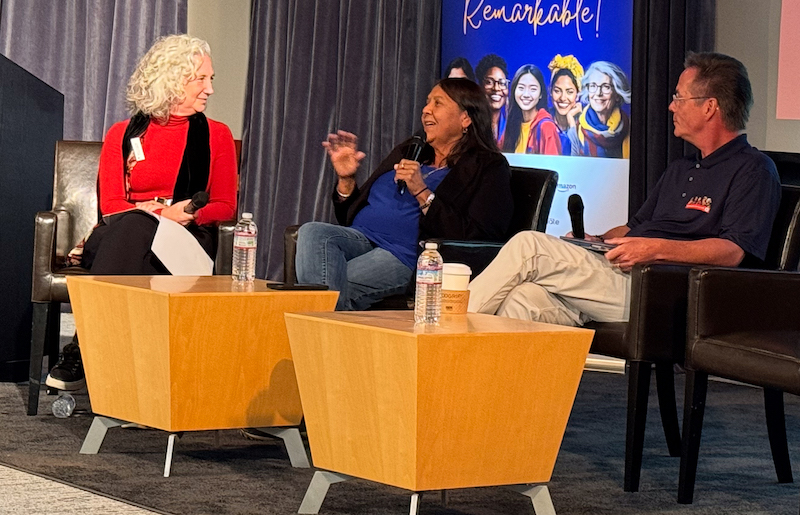
Diane Gonzalez, center, in conversation with Northeastern in Silicon Valley Regional Dean Caroline Simard and Transatlantic AI Exchange Founder & CEO Thomas Neubert
The tagline also called to mind, for Dr. Simard, Anita Borg’s famous 1995 call for gender parity in computer science, “50/50 by 2020.” The sector fell short of that mark—although by exactly how much depends on the metric. Women represented 31.5% of total employees in large tech companies in that year, and only 23.1% of technical roles (Deloitte). In 2018, the most recent reported year, women earned 32% of master’s degrees and 22% of PhDs in the computer sciences (NSF).
Dr. Simard’s work on the conference is part of a long career focus on bringing diversity to the Silicon Valley technology ecosystem. Prior to joining Northeastern in 2024, she worked at Stanford’s Clayman Institute for Gender Research as the Senior Director of Research, AnitaB.org as VP of Research, and most recently as Managing Director of the Stanford VMware Women’s Leadership Innovation Lab. The most recent research publication which she co-authored used longitudinal data to uncover the gender and race biases in the distribution of tech industry promotions.
And yet with all the work left to be done towards overcoming bias, the gathering felt upbeat and attendees left feeling energized about the future.

Purvish Thakkar with Amy Jo Martin, Founder and CEO at Renegade Global and conference speaker (photo: Purvish Thakkar)
Purvish Thakkar, a Northeastern MS in Project Management student and Dean’s Office student employee, was a major contributor behind the scenes as the event planning was underway. At the reception afterwards, he was glad to see the conversations continuing well after the final session. “The Remarkable Women in AI conference has demonstrated that the future of AI depends on the diverse voices leading the way. I’ve seen firsthand how women are pushing the boundaries of what’s possible in AI. Their leadership is driving the industry toward more inclusive and thoughtful solutions,” he said.
Many Northeastern students from the Bay Area campuses were in attendance, and shared Thakkar’s enthusiasm.
“This conference reminded me of the importance of representation and the pivotal role women play in shaping the future of AI,” said MS in Data Science student Swathi Arasu. “Together, we are paving the way for a more inclusive, dynamic, and innovative tech landscape. Looking forward to staying connected with the amazing community I met here, and continuing the journey to make AI a force for good!”
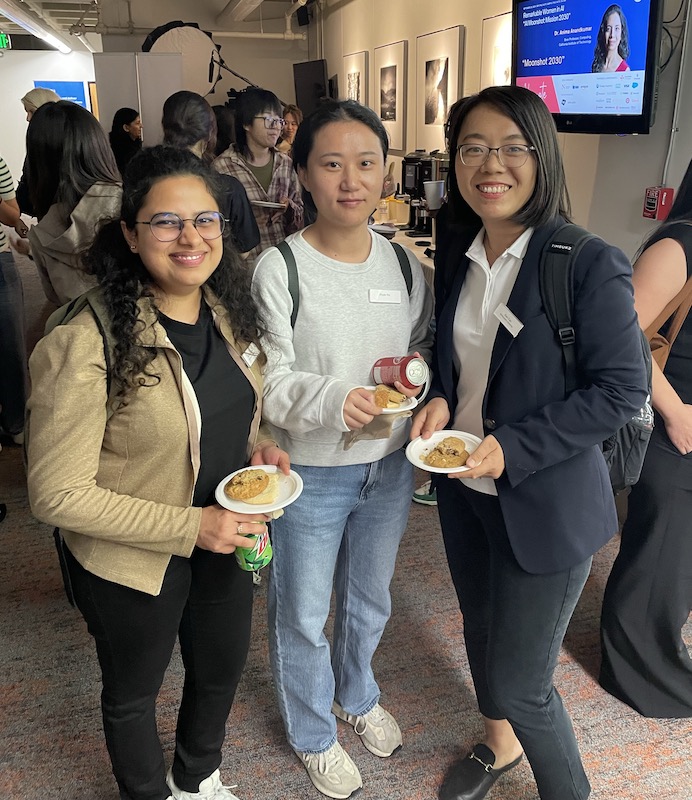
Northeastern students at the conference