“Should we be afraid?”: Paula Goldman on Why AI Needs Humans at the Helm
October 22, 2026
When ChatGPT launched in November 2022, Dr. Paula Goldman was on a quiet holiday with her family. Then her phone started buzzing. A friend wanted her take on the new tool. Another, a partner at a law firm, asked what it would mean for the legal profession. Then came her favorite question: “Should we be afraid?”
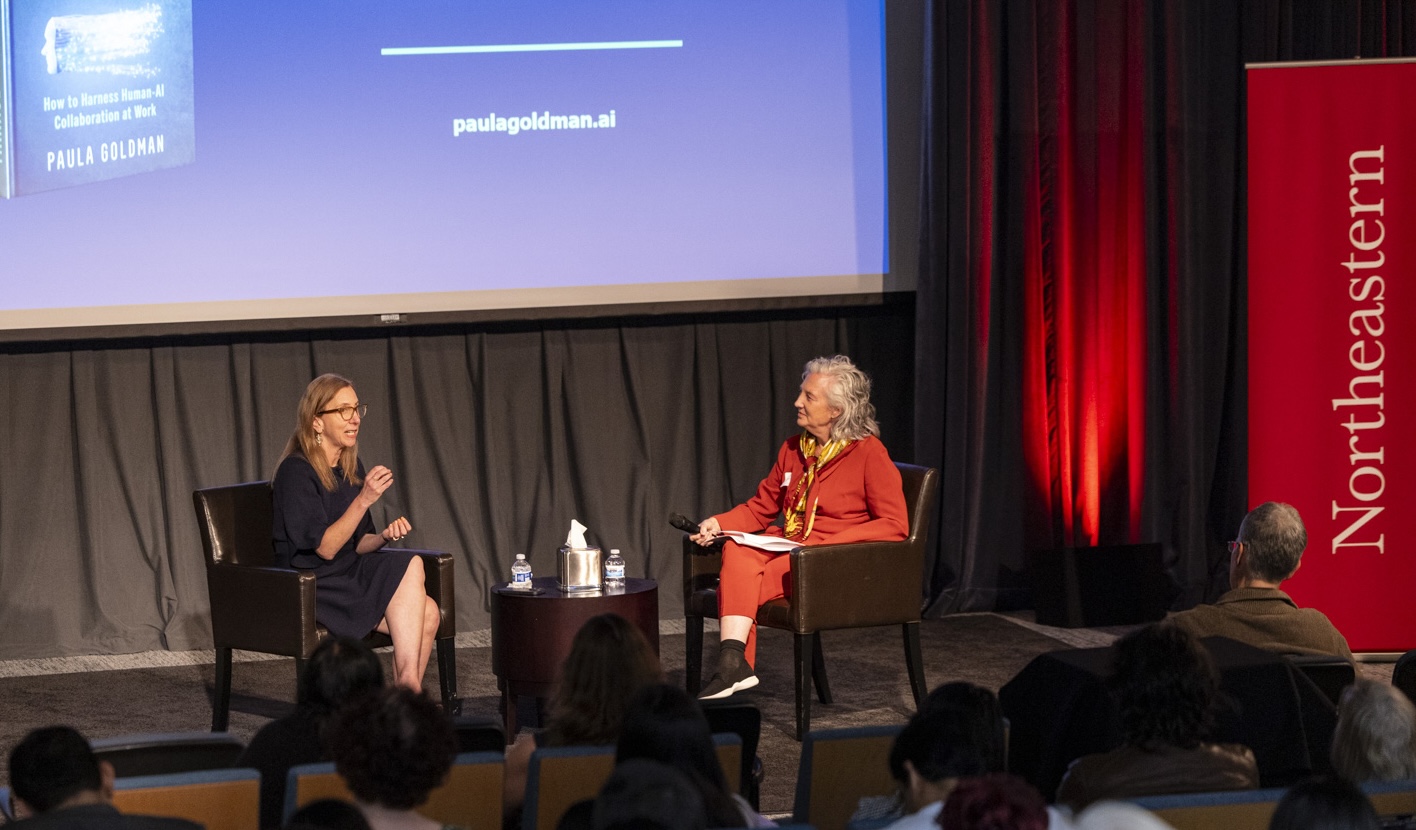
Goldman, Salesforce’s first-ever Chief Ethical and Humane Use Officer, shared that story on October 13 to a packed auditorium in Palo Alto, where Northeastern University in Silicon Valley and SRI International hosted “Manage the Machine: An Evening with Paula Goldman.” Guests came to hear her discuss her new national bestseller, Manage the Machine: How to Harness Human-AI Collaboration at Work. The keynote was followed by a fireside chat and Q&A with Dr. Caroline Simard, Dean of Northeastern University in Silicon Valley, and a reception with a book signing.


Photos by Yi Zhang
“Lots of students are asking us, ‘Is AI replacing us?’” said Lama Hamandi, Teaching Professor and Assistant Director of Computing Programs for Northeastern’s California campuses. “We know AI cannot replace humans. Humans can use AI as a tool to improve. So I’m here to get more ideas, to improve ourselves and pass them on to our students, because they’re stressed about what AI will do to their jobs and opportunities.”
For Janet Tsai, a business operations leader in the aerospace and defense industry at Northrop Grumman, the draw was responsible AI. “I’m very interested in AI, especially the ethics part of it,” she said. “I’m very interested to see what she has researched.”
Aisha Abdur Rahim (MS in Computer Science ’26) put it simply: “I just want to learn more about how human-AI collaboration can be done at work, and get inside the brain of Dr. Goldman.”
“The opposite of my experience”
Goldman said the fear behind those early questions didn’t match what she saw on the ground. “There was this view in the media of AI as this kind of godlike force, something over which we have very little control,” she said. “And it was the opposite of my experience working with companies, large and small, on AI.”
At the center of the book is a shift in thinking. “Human in the loop” usually means AI drafts something and a person approves it. But today’s AI agents can handle tasks far too large for anyone to review line by line. Goldman argued for something better: “human at the helm.” Here, people set the boundaries in advance, AI escalates to a person when judgment is needed, and the tools expand what people can do.
“I want to be working with tools that expand my agency and my creativity, and what I’m capable of accomplishing at work,” she said.
Six principles, three stories
Goldman walked through six principles from the book. The first: not every question AI can answer is one it should answer. She described a healthcare company that could easily use AI to schedule appointments, yet assigns a person to patients who have just received a serious diagnosis, because those moments call for empathy and trust.
Another principle is that “a little friction is your friend.” With powerful AI, she argued, a little friction can lead to better results. When IKEA’s innovation team asked AI to reimagine the couch, it kept producing boxy, cushioned designs. So the team set the tools aside, brainstormed new metaphors like a campfire and a gathering spot, then brought AI back in. The result was an award-winning modular couch that fits in an envelope.
Friction also matters for big decisions, Goldman said, because when AI gives a credible answer once or twice, “it’s all too easy to click yes, yes, yes, yes.”


Photos by Scott Chernis
A third principle: the people closest to the work should shape how AI changes it. Goldman recalled a town council in England that gave social workers AI note-takers so they could skip returning to the office after field visits. But the social workers rejected the tool. They wanted to go back to the office to talk through hard cases with colleagues.
“Do I retire, or do I learn this thing?”
During the fireside chat, Simard recalled testing ChatGPT two months after its launch with a PhD-level exam question. A faculty director she worked with pointed out mistake after mistake. “It’s two months old,” Simard replied. “It’s going to get better.” In that moment, she said, she had to ask herself: “Do I retire, or do I learn this thing?”
Goldman said the skills that matter most, such as judgment, trust, and empathy, are not new. Northeastern’s experiential learning model, she noted, already builds them. “It just requires a shift in emphasis, and honestly, a little bit of courage for us all to say: I know there are a lot of mind-bending headlines about AI right now, but we’ve got this.”
She also stressed that responsible AI is no longer just a job for lawyers and security teams. “Now it’s everyone’s job to make sure they’re getting the right results from AI,” she said. Simard highlighted Northeastern students in Oakland who run AI clinics to help local nonprofits use the technology to advance their missions.


Photos by Scott Chernis
When the floor opened for questions, hands shot up across the auditorium. A Northeastern student asked how to use AI intentionally while learning. Goldman said she forces herself to outline her own thoughts before turning to AI. “Thinking is hard. It’s challenging. It’s uncomfortable,” she said. “We need to preserve the space for that discomfort, and then let AI help us get even farther with it.”
Aisha, whose research with Professor Akram Bayat explores AI that helps students think rather than skip thinking, asked how much friction is the right amount. Goldman’s answer: use it sparingly, because people stop paying attention when it is everywhere.
What stayed with the audience
For many guests, Goldman’s central idea stuck. “The best insight I got is moving away from human in the loop to human at the helm,” said Preethi Shyamsundar (MS in Artificial Intelligence ’27), who is interning as an AI and data engineer at Affinity Solutions. “Part of my work is moving toward agentic AI with a speed that is honestly a little scary. I really like the idea of reinforcing that in no circumstance can you take the human out of the loop.”
After the event, Tsai reflected on her takeaways. “Human-centricity is everything: Successful AI deployment comes down to preparing the workforce and building trust ahead of time,” she wrote. AI, she added, “is no longer just an IT conversation.”
Charles Tan, who earned both his bachelor’s and master’s degrees from Northeastern and is now Director of Venture Investments at Fakhro Capital, said accountability will keep people at the center. A company can’t blame a bug on the AI tool that wrote the code, he noted, which is why startups are now emerging to offer insurance for companies that use AI. He also offered students advice. “If you’re a submarine shooting at a moving ship, you need to aim where you think the ship is going to be, not where it is right now,” he said. “That’s the challenge with AI. You need to anticipate where it could go.”
Goldman closed on a hopeful note. “We want the net effect of AI and teams to be that teams are able to accomplish things they never would have dreamed of before.”
After the program, the conversation carried into the reception, where guests lined up to have their books signed and take photos with Goldman.
So, should we be afraid? For the guests who left that night with copies of the book, Goldman’s answer was clear: not if humans stay at the helm.