Student commencement speakers elevate the human in the loop
May 20, 2026
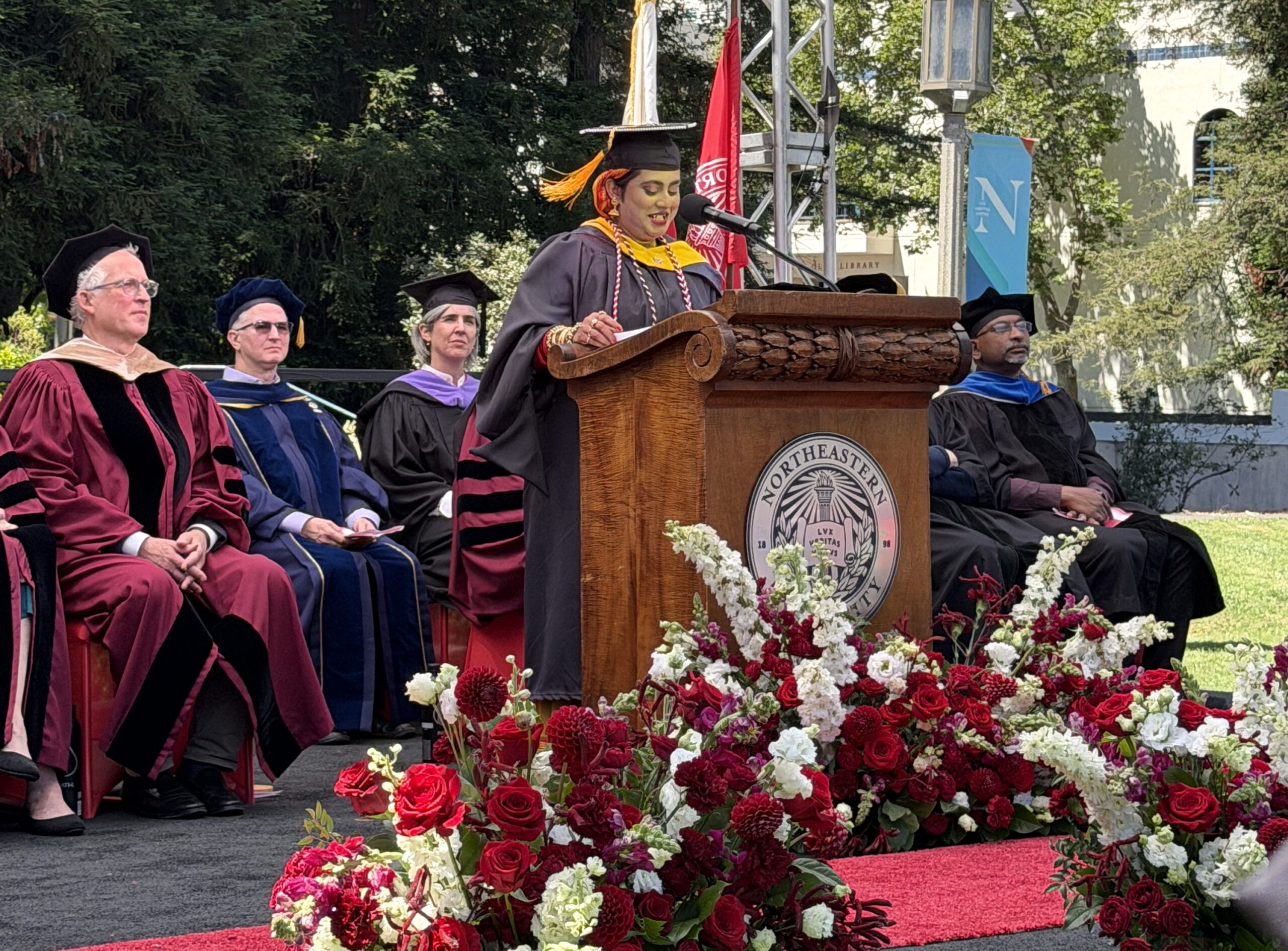
On Saturday, May 16, hundreds of members of the Class of 2026 and their loved ones gathered at Holmgren Meadow on Northeastern’s campus in Oakland. The weather was bright and clear. Some of the visitors gravitated to the shade of the coastal live oak, bay laurel, and fir trees at the edge of the green, while others took in the sun in front of the stage. Silicon Valley, Oakland, and Mills College students were celebrated in the joint ceremony, which included graduates earning bachelor’s, master’s, and doctoral degrees.
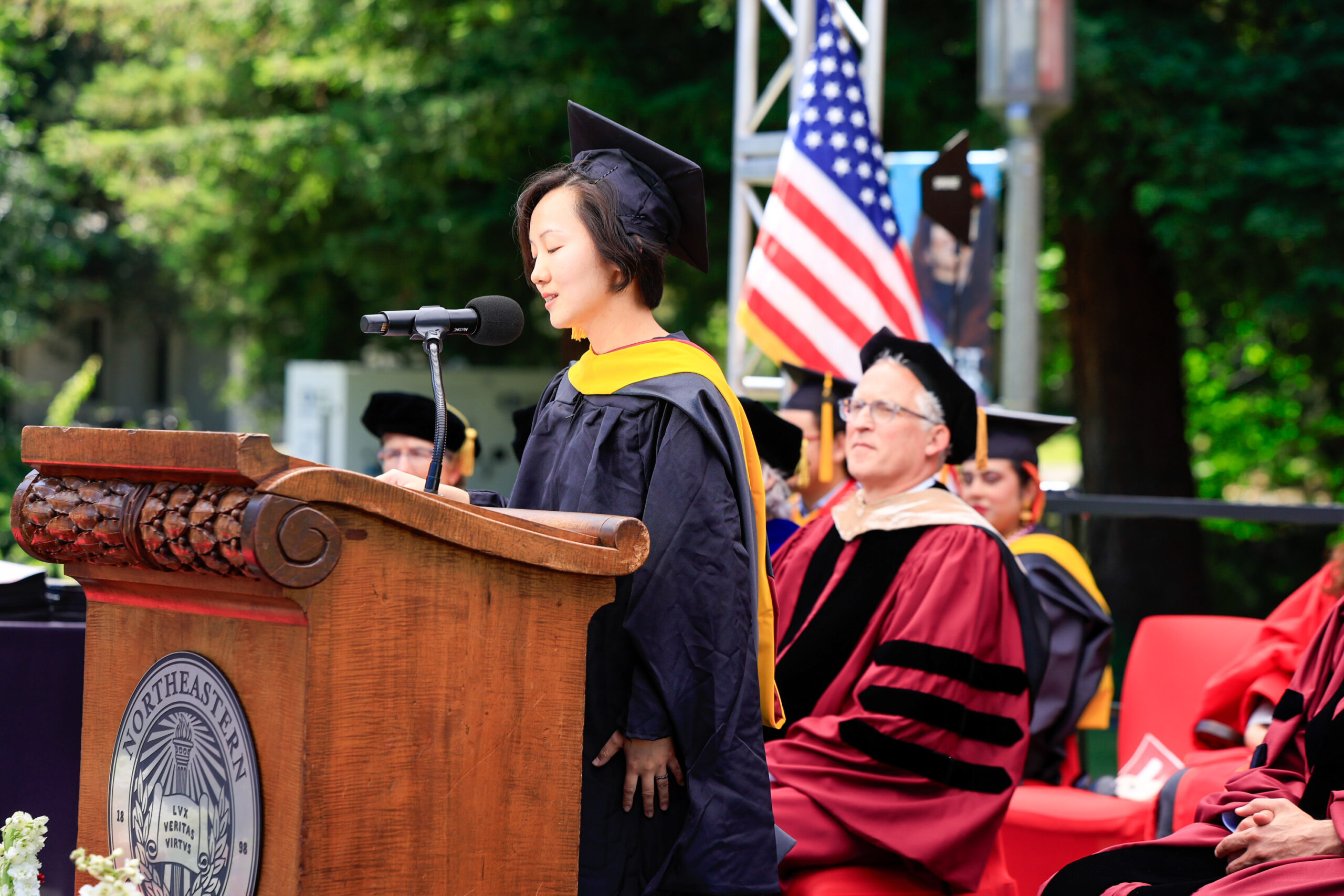
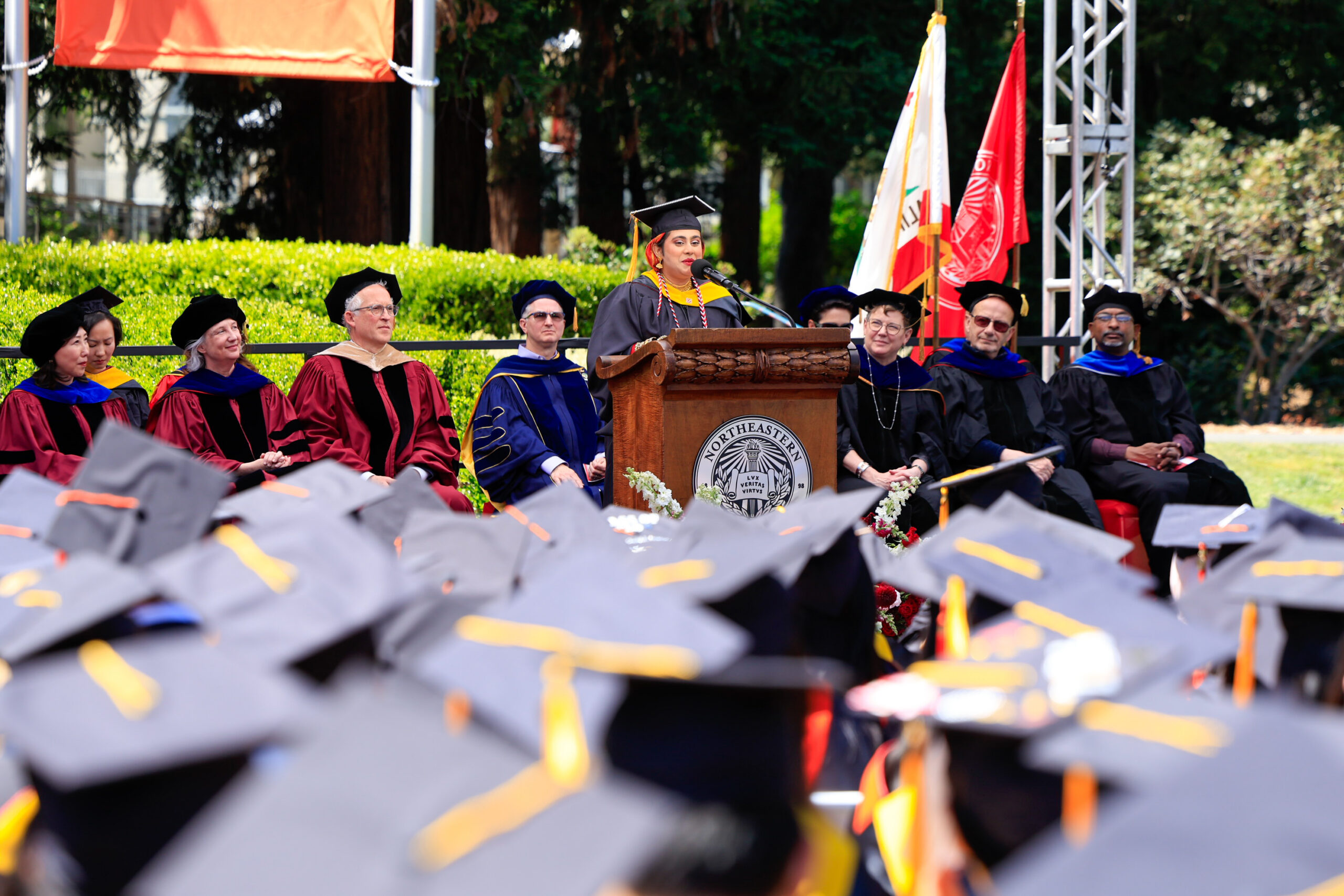
Two student commencement speakers were selected to address their peers. Aisha Abdur Rahim (MS in Computer Science ’26) was chosen from the Silicon Valley campus, and Ashley Ting Li (MS in Computer Science ’25) from the Oakland campus. Both are accomplished software engineers who stood out for their academic, professional, and extracurricular success. Richard Yue, the alumni speaker, is also a computer science graduate from the Silicon Valley campus who now works as an AI/ML engineer.
All three of these speakers have the expertise to talk about the technology that is driving current discourse, but they followed a different and equally timely thread. Many conversations lately trend towards the existential and what it means to live in a society. As parting words to their peers in the graduating class, these speakers each highlighted the depth of impact that individuals can have on each other with even small gestures of kindness.
An educator and “a lightning bolt”
Shortly after Ashley Ting Li took the podium, she asked, “Do you still remember your elementary school teachers?”
She paused to let the audience think for a moment, and then she continued, “I remember the names of one or two. But there was one substitute teacher — I don’t remember her name at all. What I do remember is a single sentence she said: ‘Just because I’m your teacher doesn’t mean everything I say is the truth. You are allowed to think for yourself. You are allowed to question anything or anyone.'”
This moment came to serve as an anchor point for Ashley as she grew away from the model of rule-following and conformity that she had accepted when younger. She would return to it again and again throughout her life, including as she considered her career path.
With a bachelor’s in marketing, Ashley earned her first master’s in digital marketing before making the leap to computer science through Northeastern’s Align program. She dedicated herself to becoming skilled across the major competencies of engineering, calling out foundations of AI, distributed systems, database management, and object-oriented programming as the areas that she found to be the most valuable from her time as a student. During her summers, she completed two software development internships, the second of which led to her full-time employment at PayPal.
To Ashley, these accomplishments stretch back to a courage that she took from that moment in school, which she remembered “like a lightning bolt… No one had ever told me that thinking independently was not only allowed, but encouraged. Looking back, I think that was the first time I saw a kind of light.”
She saw herself always orienting toward truth, as she moved to the other side of the world, and answered important questions like, “Is it okay to love someone of the same gender as me? Can I really succeed in a field I didn’t originally study?”
She pointed to Northeastern’s motto of Lux, Veritas, Virtus and told her classmates, “As we graduate into a world that is uncertain, fast-changing, and sometimes overwhelming, I hope we carry this with us: Not only to see the light, but to be the light. Not only to accept the truth, but to have the courage to question it. And not only to dream, but to have the courage to act.”
Shared burdens and shared success
The winner of the 2026 Silicon Valley Outstanding Network Student Award, Aisha Abdur Rahim has been known on the Silicon Valley campus as a tireless builder of community. As a student ambassador, she organized some of the largest events on the campus, from hackathons to celebrations. She worked as a teaching assistant for a notoriously difficult course, helping her peers master the material. Huskies Without Borders, the student group she founded, celebrates culture and belonging across the student community.
A full-stack and Android engineer, Aisha is also known for her professional and academic accomplishments. In the 2025 Student Research and Innovation showcase, her team’s project Improving Medication Adherence: A User-Friendly Medication Reminder App for Long-Term Medication Users was a recipient of the Discovery Award. In this year’s showcase, four projects that Aisha worked on were selected to present. These included a Chrome extension that is live in market, improvements to AI models for diagnosing PCOS from ultrasound scans, a system for turning coding assistant conversations into queryable architectural knowledge graphs, and “a multi-agent framework for preserving human cognitive autonomy in AI-assisted interfaces.”
When she reflected on what she felt most proud of, she told her classmates:
“Somewhere in the middle of all [the hard work and pressure], we didn’t lose ourselves. We didn’t become so consumed by individual success that we forgot to see each other. We didn’t let competition turn us into strangers.”
She shared her memories of friendship and companionship; the shared study sessions, the enthusiastic encouragement, the quiet comfort of someone taking the time to notice that their friend needed company.
“The world often tells us that success is individual, and we do great things alone. But that’s not what happened here,” she said, emphasizing, “That’s not our story. Our story is collective, and our success is communal. We did extraordinary things, but we did them by being extraordinary to each other.”
Small gestures, amplified over time
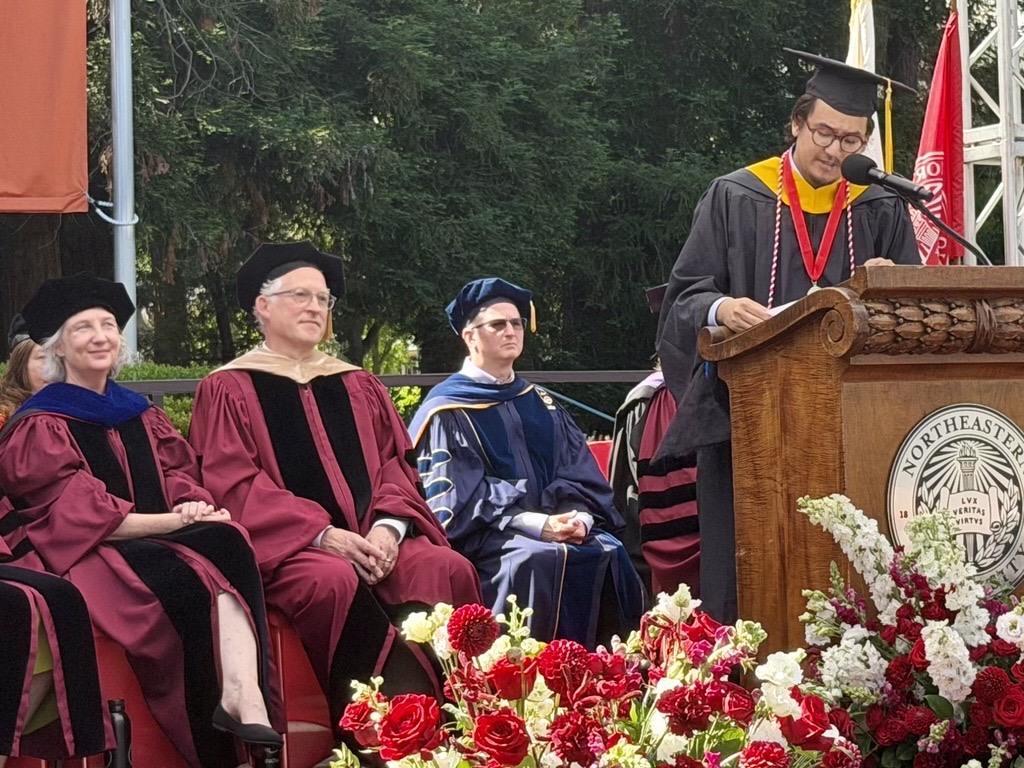
After the class had walked the stage and flipped their tassels, alumni speaker Richard Yue came to the podium. When he began the Align program at the Silicon Valley campus he had a background in linguistics and language translation; he now works at Meta on artificial intelligence.
He shared how just a few weeks into his graduate program, he had found himself out of his depth in a discrete math course. But then, an unexpected intervention: a new friend from class discovered how much he was struggling, and volunteered his Saturday to help. The two sat together on campus, skipping out on an outdoor celebration that other students were attending, working through the problems in the assignment until it began to click for Richard. He was able to get his feet under him and quickly began to succeed in his classes.
Several years later, encountering the learning curve at his new job, he called back to that experience. Although learning a new codebase, new insider vocabulary, and new concepts all at once felt daunting, he had been through something similar before. The kindness of that friend in first year has had a lasting impact, just as has the guidance of Ashley’s grade school teacher, and the caretaking of Aisha’s conscientious friends.
Rounded out with a beautiful keynote address by Dr. Yanbing Li, CPO of Datadog, the ceremony was a hopeful and joyful celebration of humanity. The optimism that all of the speakers shared was not a denial of the uncertainty of the moment, or a refusal to engage with it. Instead it was an affirmation of the durability of the things that are always within one’s control: the ways that people show up for each other, and how to respond when someone falls behind.
As the Class of 2026 goes on to the next phase of their careers and spread out around the world, they will have many more opportunities to make small choices with big impacts. As Aisha said to her classmates, “We’re leaving with each other’s fingerprints all over our success, with memories touched by the hands and hearts of the people in this room.”